


What does a Pata Negra ham really cost?
A whole Pata Negra ham costs €649.90 in our shop, which works out at about €81 per kilo. The same ham, hand-carved and sold in 80 g packs, comes to €311 per kilo. That is not an error, and it is not a hidden margin either. Here is where the gap comes from, and what sets the price long before the piece reaches the shop.
The short answer
Price per kilo is the only unit that lets you compare. A whole acorn-fed 100% Ibérico leg works out at €81 to €93 per kilo. The same ham in an 80 g pack works out at €311 per kilo.
- These are our own prices, taken from our catalogue on 2 September 2026. We publish no competitor prices, because we have not surveyed them.
- The gap between a whole leg and a sliced pack comes down to three things: the bone, hand carving, and protective-atmosphere packing.
- The cost is committed long before the sale: an Ibérico ham of 7 kg or more must cure for 730 days before it can be sold.
- An acorn-fed pig occupies between 0.8 and 4 hectares of dehesa during its montanera, and must gain 46 kg there. That space costs money.
Where these prices come from
Any price we quote comes from our catalogue and carries the date it was taken. Price per kilo is calculated on the real weight of the pieces, bone included for whole legs.
We publish no competitor prices. Not out of commercial caution, but because we have not surveyed them, and a price you have not seen for yourself is worth nothing. Market ranges with no source and no date are common: they prove nothing.
The legal requirements quoted come from Royal Decree 4/2014, consolidated text published in the Boletín Oficial del Estado, reread on 25 August 2026. We sell the products we are writing about: worth knowing when reading an article about prices.
Bring every price back to the kilo
The figure on a product page says almost nothing on its own. A pack and a whole leg are not comparable until both are expressed per kilo, and that single calculation changes how the whole category looks.
The arithmetic is simple. Divide the price of an 80 g pack by 0.08 to get the price per kilo. For a whole leg, divide the price by its weight, remembering that the weight includes the bone. Do it once on any two pieces and the ranking usually surprises people.
Our own prices for each piece are shown on the product pages, and we restate them here whenever this article is revised. What follows explains what drives them.
| Piece | Price | Per kilo |
|---|---|---|
| Acorn-fed 100% ham black seal · whole leg, 7 to 8 kg | €649.90 | €81–93 |
| Acorn-fed 100% shoulder black seal · whole leg, 4 to 5 kg | €269.90 | €54–67 |
| Free-range grain-fed 50% ham green seal · whole leg, 7 to 8 kg | €349.90 | €44–50 |
| Free-range grain-fed 50% shoulder green seal · whole leg, 4 to 5 kg | €179.90 | €36–45 |
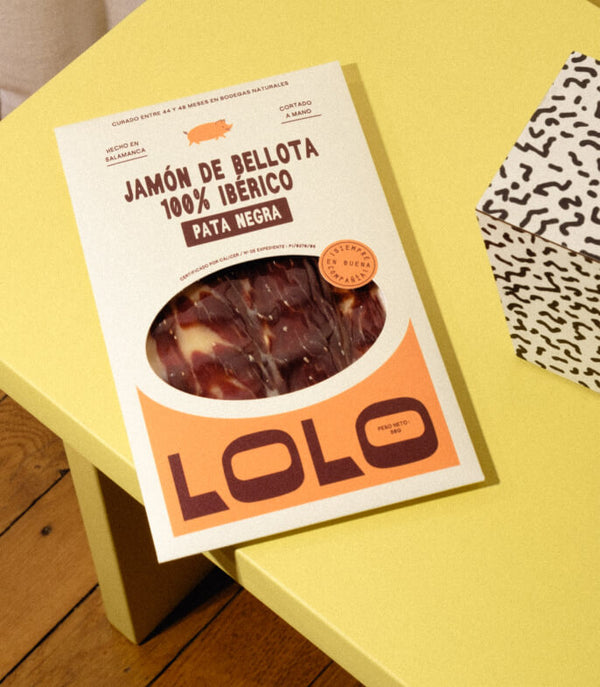
| Acorn-fed 100% ham hand-carved, 80 g | €24.90 | €311 |
| Acorn-fed 100% shoulder sliced, 80 g | €15.90 | €199 |
| Free-range grain-fed 50% ham hand-carved, 80 g | €14.90 | €186 |
| Free-range grain-fed 50% shoulder sliced, 80 g | €10.90 | €136 |
LOLO Jamón catalogue, taken on 2 September 2026. Prices per kilo calculated on the real weight and rounded to the euro. Whole legs are sold bone-in.
Why a leg and a pack are worlds apart per kilo
It is the same ham, from the same piece. The gap comes from what is done to that piece before it reaches you, and it breaks down into three parts.
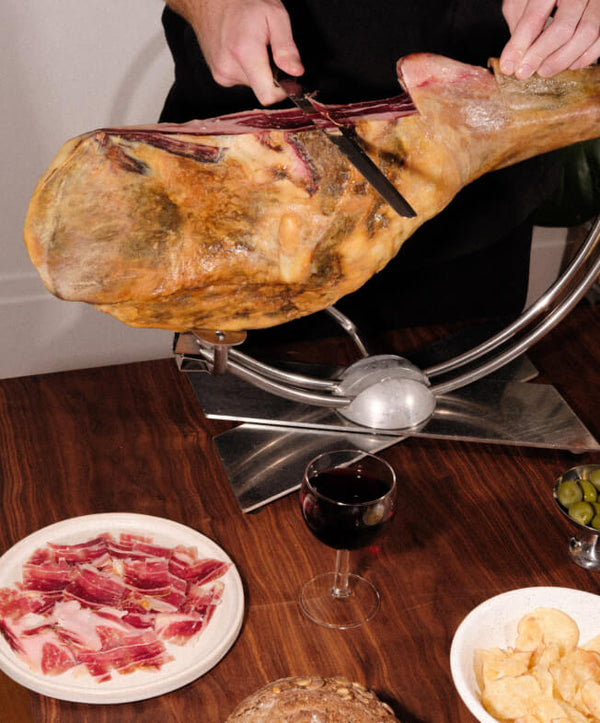
The first is the bone. When you buy a whole leg, you pay by the kilo for something that includes the bone, the rind and the outer fat. Part of it will never reach the plate. In an 80 g pack you are paying for slices only.
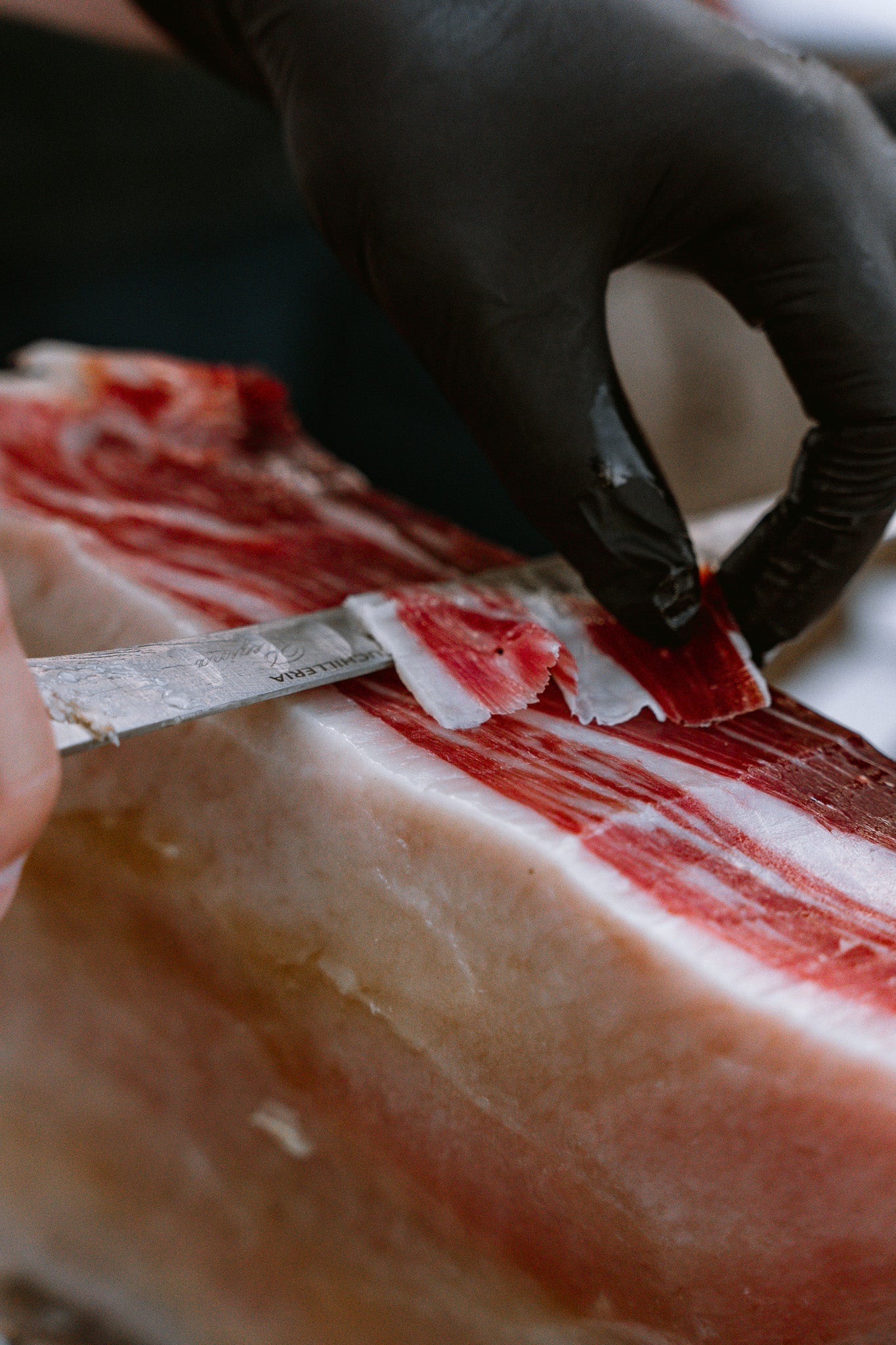
The second is the hand. Our 80 g formats are carved with a knife, not a machine. It is slow, learned work, and it produces trim loss. The third part covers protective-atmosphere packing, the cold chain, and shipping a delicate product.
In practice: if you eat Ibérico ham regularly and you can carve, the whole leg is three to four times more rational. The pack keeps its place for discovering, for gifting, or when you have neither the time nor a ham stand.
A whole leg is not always the better buy
A whole leg needs a ham stand and a good knife, which belong in the budget if you do not own them. It also needs to be eaten within a reasonable time once started. If you entertain twice a year, the pack costs more per kilo but less in total.
What sets the price before any carving
Four legal requirements weigh on the cost of an Ibérico ham, and all of them are quantified in the decree. None is negotiable.
Time tied up. A ham of 7 kg or more must cure for at least 730 days before it can be sold, 600 days below that weight, and a shoulder 365 days. Across those two years the producer carries the cost and the piece loses weight. Our acorn-fed hams come out between 44 and 48 months, well beyond the minimum.
Space. An acorn-fed pig occupies a plot of dehesa through its montanera, and the law caps the number of animals per hectare: from 0.25 on a lightly wooded dehesa to 1.25 where oaks cover more than a third of the plot. A free-range grain-fed pig gets 100 m² per animal, an indoor grain-fed pig 2 m². That ratio of one to fifty shows up in the price.
Yield per animal. One pig gives two hams and two shoulders. That is all. There is no way to get more, and it is what separates this product from most meats.
Weight gained in montanera. To carry the “de bellota” designation, the animal must gain at least 46 kg out in the dehesa, over more than 60 days, with no feed brought to it. That means roughly 600 kg of acorns per animal across the season. A poor acorn year, and the whole batch drops a category.
What a low price should make you check
We will not claim that below a given price it must be a scam: we have not surveyed market prices, and the claim would be unverifiable. Four things, however, can be checked on any product page, and they are enough.
- ✅ Is the seal colour stated? It is the only element certified by an independent body. Without it, nothing is guaranteed.
- ✅ Is the breed percentage given? Stating it is compulsory. A red seal can be 50% or 75% Ibérico.
- ✅ Is the price per kilo shown anywhere? A seller who never shows it is stopping you from comparing.
- ❌ Is “Pata Negra” used without a black seal? It is a reserved term, and it should only ever describe acorn-fed 100% Ibérico.
Conclusion
The fair price depends on what you will do with it
There is no single fair price for a Pata Negra ham, only a fair price for your use. A whole leg is obvious value per kilo if you entertain often and can carve. It is a poor calculation if it will sit on its stand for six months.
Here is the order we suggest.
- Start with one 80 g pack. You will know whether acorn-fed speaks to you before committing to a whole leg.
- Then compare shoulder against leg. Per kilo, the acorn-fed shoulder is the cheapest way to own a whole black-seal piece.
- Move to a whole leg when frequency justifies it. Stand, knife and regularity count as much as budget.
Frequently asked questions
How much does a whole Pata Negra ham cost?
In our catalogue, €649.90 for a bone-in leg of 7 to 8 kg, which is €81 to €93 per kilo, as at 2 September 2026. The acorn-fed shoulder, smaller, is €269.90 for 4 to 5 kg, which is €54 to €67 per kilo. These are our own prices, not market prices.
Why is sliced ham so expensive per kilo?
Because you are only buying slices. On a whole leg, part of the weight you pay for is bone, rind and outer fat. Add hand carving, which produces trim loss, protective-atmosphere packing and the cold chain.
Why is Ibérico ham more expensive than other hams?
Because the law requires the piece to be tied up for two years before sale, and the animal for far longer still. A ham of 7 kg or more must cure for 730 days. Add extensive farming, which demands up to four hectares of dehesa per animal, and the fact that one pig yields only two hams.
Is the shoulder a good middle ground?
Per kilo it is the cheapest way to own a whole black-seal piece. It is smaller, with a higher proportion of bone and a more concentrated flavour. The minimum curing time is shorter too, 365 days instead of 730.
Do you publish your competitors’ prices?
No. We have not surveyed them, and publishing market ranges without checking them would be dishonest. The only prices in this article are our own, with the date they were taken. You can compare them yourself against what you find elsewhere, as long as you always bring everything back to the kilo.
Sources
- Prices: LOLO Jamón catalogue, consulted on 2 September 2026. No competitor price was surveyed or published.
- Legal requirements: Royal Decree 4/2014, consolidated text published in the Boletín Oficial del Estado — art. 6 (montanera, 46 kg gain, stocking density), art. 7 and 8 (space in free-range grain-fed and grain-fed rearing), art. 9 (seals), art. 12 (minimum curing times), annex (animals per hectare). Consulted 25 August 2026.
Read next
Written by

Valentin & Pablo
Founders of LOLO Jamón
We select our pieces in the drying cellars of the Salamanca dehesa, and we filmed a full montanera season for our documentary Viva España.
See the pieces, and the prices
Acorn-fed 100% Ibérico hams and shoulders, black seal, Salamanca dehesa, cured 32 to 48 months depending on the piece.
Explore the Bellota selectionShipped from Spain · free shipping over €89.90


Leave a comment
This site is protected by hCaptcha and the hCaptcha Privacy Policy and Terms of Service apply.