


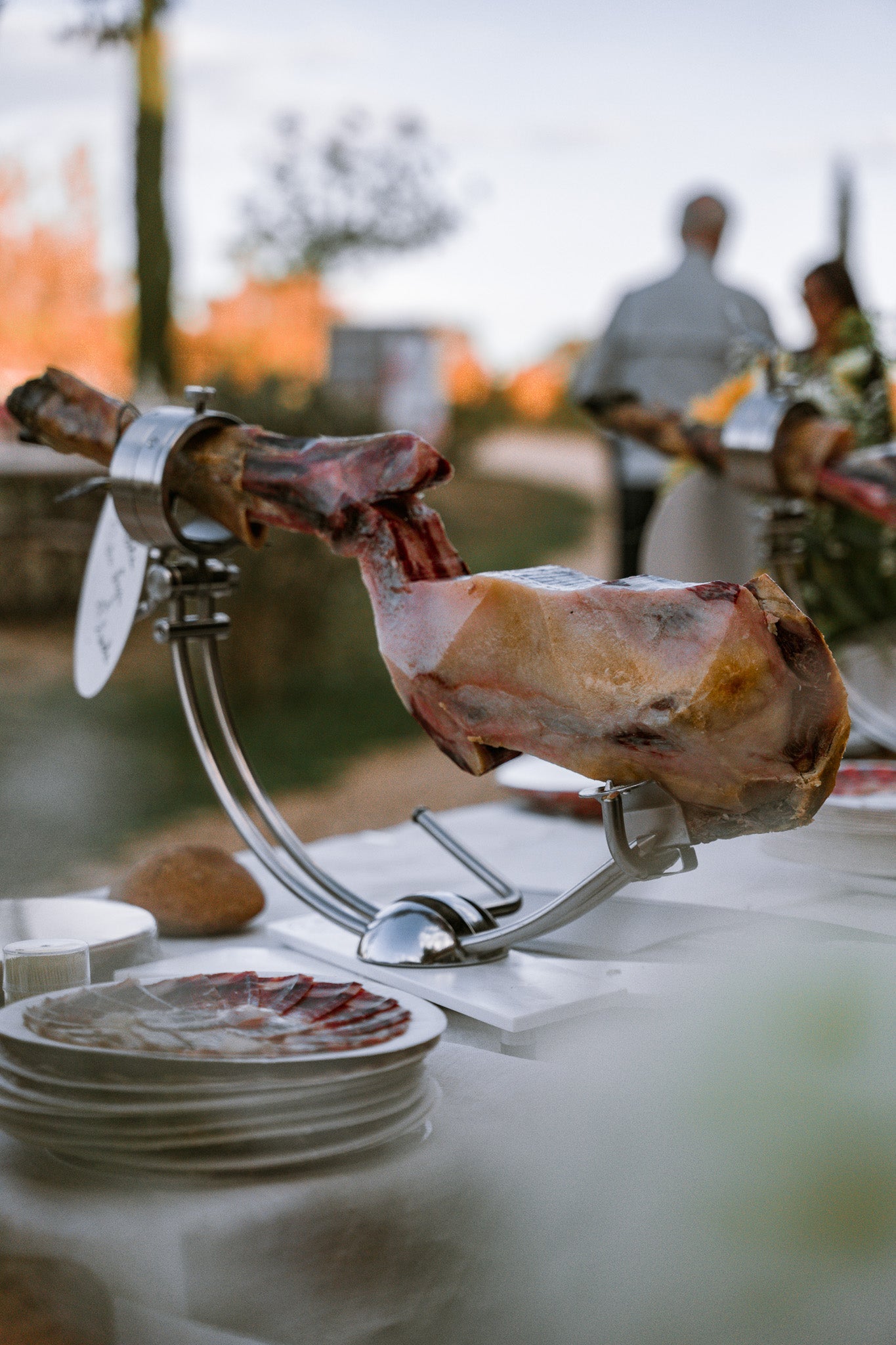
Ham Fairs and Events in Spain
Spain has about ten events devoted to ham, and they are nothing like one another. Some are village fairs where three thousand sandwiches are handed out. Others are trade congresses where industry people discuss traceability. Here is which ones are worth the trip, in which season, and which ones are not meant for you.
The essentials
The calendar matters more than any ranking. Almost all of these are annual and free, but two of the best known are held only every other year.
- The season runs from February to November, with a gap in summer and two high points: September in Extremadura and Aragón, October and November in Andalusia.
- Two of them are biennial: the Guijuelo trade fair and the world congress, which changes city with every edition.
- Teruel ham is not Ibérico. It is a white-pig designation, and its fair is the only one here that does not deal in Ibérico at all.
- Monesterio’s “world record” does not exist. The town hall mentions it nowhere. What does exist is three thousand sandwiches handed out on a September Saturday.
- Salamanca, where our pieces come from, has its own event in February: the Guijuelo matanza, four weekends of tradition and charcuterie.
A calendar, not a ranking
Ranking these events from best to worst would mean nothing: they are not in the same business. A village fair, a trade show and a scientific congress do not address the same people.
What is useful is knowing when they happen. Almost all of them come round at the same time each year, and entry is free in most cases.
One warning before you book: dates shift from year to year, and two of these are held only every other year. Always check with the organiser; the links are at the foot of the page.
| When | Where | What it is |
|---|---|---|
| February | Guijuelo Salamanca | The traditional matanza, over four weekends |
| Early May | Jerez de los Caballeros Badajoz | Iberian ham and dehesa show |
| June, every other year | Guijuelo Salamanca | Trade show for the meat industry |
| August | Estepona Málaga | Ten days on the seafront, stalls and concerts |
| Second Saturday of September | Monesterio Badajoz | One day, three thousand ham sandwiches |
| Mid-September | Teruel Aragón | The designation’s fair — white pig, not Ibérico |
| Last two weekends of October | Aracena Huelva | The regional ham and Iberian pig fair |
| November | Villanueva de Córdoba Córdoba | The Los Pedroches designation fair |
We have removed from this page a Trujillo fair we used to list: we found no recent trace of it. Trujillo does have a large fair, but it is the cheese one.
The three worth the trip
Aracena, in the Sierra de Huelva. It is the oldest of the group by number of editions, and it takes the last two weekends of October. There is a carvers’ competition, workshops, tastings of Jabugo designation ham, and some fifty exhibitors between the main pavilion and the artisans’ marquee. Entry is free.
Villanueva de Córdoba, in the heart of Los Pedroches. Four days in November, around thirty thousand visitors, and a “ham tunnel” that takes you through a guided tasting. The town hall runs it with the designation’s regulatory board: what you taste is acorn-fed 100% Ibérico from the one designation that requires pure breed.
Monesterio, in Extremadura. A single day, the second Saturday of September, and the most popular of the lot. The sandwiches start going out at ten in the morning. The festival dates from 1990, and Extremadura listed it as of tourist interest in 2009.
The world record that does not exist
You read everywhere that Monesterio is going for the record of the world’s largest ham breakfast. We wrote it too. That sentence comes from nowhere: neither the town hall, nor the Spanish tourist board, nor the local press mentions it, and no ratification exists.
What is true is simpler: around three thousand sandwiches handed out, some ten thousand visitors, and twenty thousand square metres of festival around the municipal swimming pool. That is already a great deal, and it has the merit of being checkable.
The ones not meant for you
The Guijuelo trade fair is an industry event: more than a hundred and twenty exhibiting companies over ten thousand square metres, from raw-material suppliers to distributors. You do not go there to eat ham. And it is held only every other year, in June.
The world ham congress is something else again. It is a scientific and professional meeting, biennial and above all itinerant: it is often presented as the Zafra event, but Zafra hosted a single edition, in 2024. The next was held in Granada in 2026. The talk there is of traceability, food safety and artificial intelligence, before five hundred delegates.
We list them because they matter to the trade, and because anyone planning a trip should know they are not for them.
Teruel, the fair that is not about Ibérico
This is the nuance most lists miss. Teruel ham does have a protected designation, with its fire brand shaped as an eight-pointed star. But its specification requires a Landrace or Large White dam and a Duroc sire: that is white pig.
The designation’s own regulatory board says so plainly. It is neither a flaw nor a deception — it is simply another product with its own rules, as we set out in a whole article.
Its fair, in mid-September, brings together the designation’s farms and drying houses, with a quality competition, a tasting workshop and business meetings for importers. It deserves to be known for what it is.
And Salamanca, where our pieces come from
Our hams are cured in the province of Salamanca, and it has its own event: the traditional Guijuelo matanza, in February, over four weekends. Charcutiers at work, a night matanza, the mondongo festival, then a food fair to finish. The region has listed it as of tourist interest.
It is the opposite of the trade show held in the same town: this one is open, popular, and it shows the craft rather than the market.
The city of Salamanca has also launched an Iberian forum in late May, with a hundred or so carvers on the Plaza Mayor. It is recent and its dates have already moved once: check before you travel.
Where this information comes from
The dates, organisers and figures on this page come from town hall websites, regulatory boards and official listings, all set out at the foot of the page. Where an event had no recent trace, we removed it rather than copy it across. Where a figure circulates without a source, we say so instead of repeating it. And we sell Iberian ham: you should know that before reading the above.
Conclusion
Three questions before you book
These events are not interchangeable, because they are not after the same audience. Once you know which one speaks to whom, the choice makes itself — and it makes itself on the calendar rather than on reputation.
- Is it a festival or a trade show? Aracena, Villanueva and Monesterio are open to everyone. Guijuelo and the world congress are not.
- Is it on this year? Two of these are biennial, and the congress changes city each time.
- Is it Ibérico? At Teruel, no: it is white pig, and it is written into the specification.
Frequently asked questions
Which is the biggest ham fair in Spain?
It depends what you measure. Villanueva de Córdoba draws around thirty thousand visitors over four days, which makes it the busiest of the fairs open to the public. The Guijuelo show is larger in floor space, but it is trade-only and held every other year.
Do you have to pay to get in?
In most cases, no. Aracena, Monesterio and Estepona are free, and tastings are paid for by the plate, often a few euros. Trade shows work differently, by registration.
When is the best time to go?
September, October and November hold most of it: Monesterio and Teruel in September, Aracena in October, Villanueva in November. February is the other good window, for the Guijuelo matanza.
Is Teruel ham an Iberian ham?
No. Its specification requires a Landrace or Large White dam and a Duroc sire — that is white pig. The designation’s own regulatory board says as much. It is a protected designation in its own right, but it does not come under the Ibérico standard.
Is there a fair in the region our hams come from?
Yes, at Guijuelo, in February: the traditional matanza, listed as of tourist interest by Castile and León. It runs over four weekends and has nothing to do with the trade show in the same town, which is biennial and open to the trade only.
Sources
- Junta de Andalucía cultural listings, Aracena fair: dates, venue and programme.
- Los Pedroches designation regulatory board: programme of the Villanueva de Córdoba fair.
- Estepona tourist office: dates, exhibitors and free entry.
- Jerez de los Caballeros town hall, Iberian ham and dehesa show: dates and technical sessions.
- Monesterio town hall, Día del Jamón page: second Saturday of September, origin in 1990, 2009 listing.
- Jamón de Teruel designation regulatory board: fair, quality competition and business meetings.
- Specification for the Jamón de Teruel and Paleta de Teruel designations: Landrace, Large White and Duroc lines, and the eight-pointed star fire brand.
- Guijuelo meat industry trade fair: frequency, floor space and number of exhibitors.
- Zafra town hall, 2024 world ham congress: number of delegates and nature of the meeting.
- Festivals of tourist interest in the province of Salamanca: listing of the Guijuelo matanza.
Read next
Written by

Valentin & Pablo
Founders of LOLO Jamón
We import and distribute Iberian ham and charcuterie. We visit the farm every season and choose the pieces there.
Whole pieces
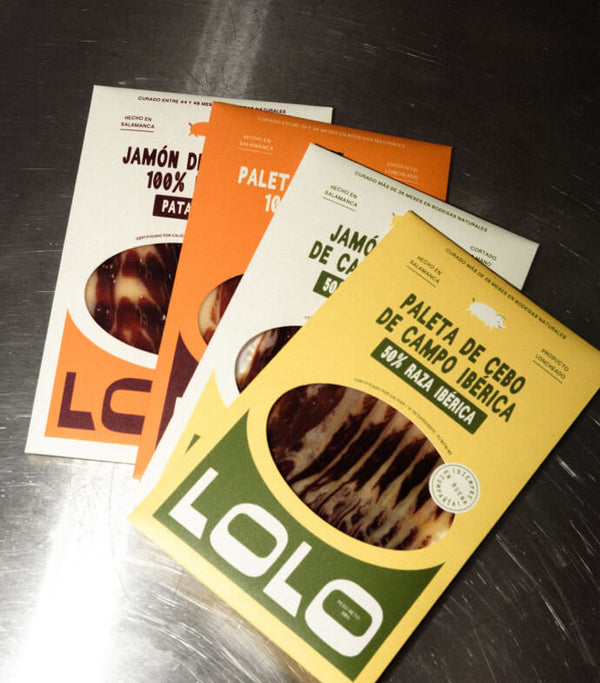
Hams and shoulders of bellota and cebo de campo, cured for 28 to 48 months. The cheapest format per kilo.
See the whole piecesShipping to France within 48 h. Secure payment.


Leave a comment
This site is protected by hCaptcha and the hCaptcha Privacy Policy and Terms of Service apply.