


The maestro cortador: a diploma since 2026, a title nobody protects
The maestro cortador’s trade has just entered Spanish law. A decree of February 2026 creates a three-hundred-hour diploma, sets a cutting angle, describes a workstation — and then states that it protects no title. Here is what is written down, and what is written nowhere.
The essentials
Since 4 March 2026, Spain has awarded a vocational diploma in ham carving and tasting. The same text states, in plain words, that it regulates no profession: anyone may still call themselves a maestro cortador.
- 300 hours, level 4C of the Spanish qualifications framework, two modules of 75 hours (Real Decreto 84/2026, art. 2).
- Entry is restricted to holders of three Spanish vocational diplomas: cookery, restaurant service, or food retailing.
- One single angle is written into Spanish carving law: 45°, below the Achilles tendon.
- Neither slice thickness, nor serving temperature, nor carving order appears in the text. They are craft, not rule.
- The title awarded by the national association is an association title, not an official one. Both exist, and they do not overlap.
Where this information comes from
Everything this article presents as a rule comes from a published text: Real Decreto 84/2026, published in the Spanish official gazette on 12 February 2026, which we read article by article. The other texts are listed at the foot of the page. The remarks on the workstation and on sharpening come from the video below, where Javier carves one of our pieces. Three figures that everyone publishes have no source at all — the thickness of the slice, its length, the serving temperature — and we say so where the question arises. Finally, we sell Iberian ham: you should know that before reading what follows.
What Spain wrote in February 2026
The craft now has its diploma. Real Decreto 84/2026 creates the Curso de especialización de Formación Profesional de Grado Medio en Maestría de corte y cata de jamón y paleta curados, a specialist course in carving and tasting cured ham and shoulder. It runs 300 hours, sits in the Hospitality and Tourism vocational family, and is placed at level 4C of the Spanish qualifications framework.
Two modules form its core, 75 hours each: module 5158 on carving and slicing, 5159 on tasting. The remainder is a period of workplace training that the text requires without putting a number on it.
Entry is not open. Article 11 restricts access to holders of one of three Spanish diplomas: technician in cookery and gastronomy, technician in restaurant service, technician in food retailing. A self-taught cortador, however well regarded by his peers, has no right of entry.
This diploma did not appear from nowhere. It is the third floor of a building that took four years.
| Year | The text | What it creates |
|---|---|---|
| 2022 | Programme HOTR0014 public employment service | A 30-hour training speciality, level 1 |
| 2023 | Real Decreto 546/2023 annex XV | Vocational qualification HOT818_2, level 2 |
| 2026 | Real Decreto 84/2026 in force 4 March | The 300-hour diploma, level 4C |
The text sets no rollout calendar: provision is left to each autonomous community. Nothing guarantees that a single cohort has yet been taught.
Nobody protects the title
This is the most interesting sentence in the text, and it fits on one line. First additional provision: “El curso de especialización establecido en este real decreto no constituye una regulación del ejercicio de profesión regulada alguna.” The course created by this decree does not constitute regulation of any regulated profession.
Spain has created a diploma without creating a regulated trade. There is no professional body, no register, no requirement to hold a qualification in order to practise. The word maestría appears in the name of the course, not in a protected job title. Anyone expecting a Spanish equivalent of the French Meilleur Ouvrier de France has the wrong text, and the rule takes care to say so.
Not to be confused
The Asociación Nacional de Cortadores de Jamón, founded in 2006, has run a Spanish championship since 2007; its sixteenth final was held at Villanueva de Córdoba in February 2026. The winner receives a maestro cortador title. It is an association title, awarded by a private body whose membership is open to anyone. It has nothing to do with the 2026 diploma, and nothing would stop another association from awarding the same one. Both exist, and they do not overlap.
One further consequence of that status: nobody counts cortadores. Neither the national statistics institute, nor the trade body, nor the ministry publishes a headcount. The occupation has no code of its own in the Spanish classification of occupations. The numbers in circulation come from job boards and private schools.
The one gesture the law describes
In all of Spanish carving law there is one written angle: 45°. It appears in module 5158, among the assessment criteria for trimming the piece: “el corte por debajo del tendón de Aquiles, en ángulo de 45° hasta llegar a tocar la tibia y peroné”. The cut is made below the Achilles tendon, at 45°, until it reaches the tibia and fibula. It is the opening gesture, the one that governs everything after it.
The same module describes the cala, the bone needle pushed into the piece to smell it. The text says where: at the joint between hip bone and femur, in the hock, and in the lower part of the tip. Three points, three chances to catch a fault before serving.
No carving order, on the other hand, is imposed. The decree asks for slicing done “de forma lineal”, working around the bones, and asks that the piece be used to the full by rotating it. It also asks that slices be distinguished by the zone they come from. But it never says where to start. We handle that question elsewhere, because it turns on something the law ignores: how long you will take to finish the piece. The detail is in our article on the parts of the ham, zone by zone.
The text does name the zones, but it stops at usage: it speaks of the “most common names” and lists seven without defining any. The bones, by contrast, it names with anatomical precision. The asymmetry is telling: the skeleton is science, the muscle zones are craft.
Three figures everyone repeats
They are on every website. We went to see where they came from.
| What you read | What is written | Where |
|---|---|---|
| Slices of 0.5 to 1 mm | No serving rule at all. A recommendation of 1 to 1.5 mm does exist, for preparing tasting samples | IRTA sensory evaluation guide |
| Slices 4 to 6 cm long | Nothing. No text, no competition rules, no product specification | No source found |
| Serve at 20 to 24 °C | No rule. A 20–25 °C for 20 to 30 minutes does exist, for bringing samples to temperature | IRTA sensory evaluation guide |
This guide is for preparing tasting samples, not for serving ham at the table. It carries no regulatory force, and says so itself.
Two figures we will not give you. How long a professional takes to carve a whole piece: the only duration written down anywhere is a competition ceiling, two hours. And what proportion of a ham is actually edible: no public body publishes it, and the percentages in circulation all come from online shops.
Knife, machine, and what you really look at
The official Spanish programme gives machine slicing a whole block of its own, ranked equally with knife carving. Module 5158 devotes its fifth learning outcome to it, with its own technical criteria and the boning that precedes it, first with a boning knife and then with a gouge. A qualified cortador will be assessed on both.
That is awkward for the trade’s commercial story, ours included. Nobody has compared the two on texture, slice temperature or oxidation. Plenty has been measured on dry-cured ham — pH, texture, colour — but never the act of carving.
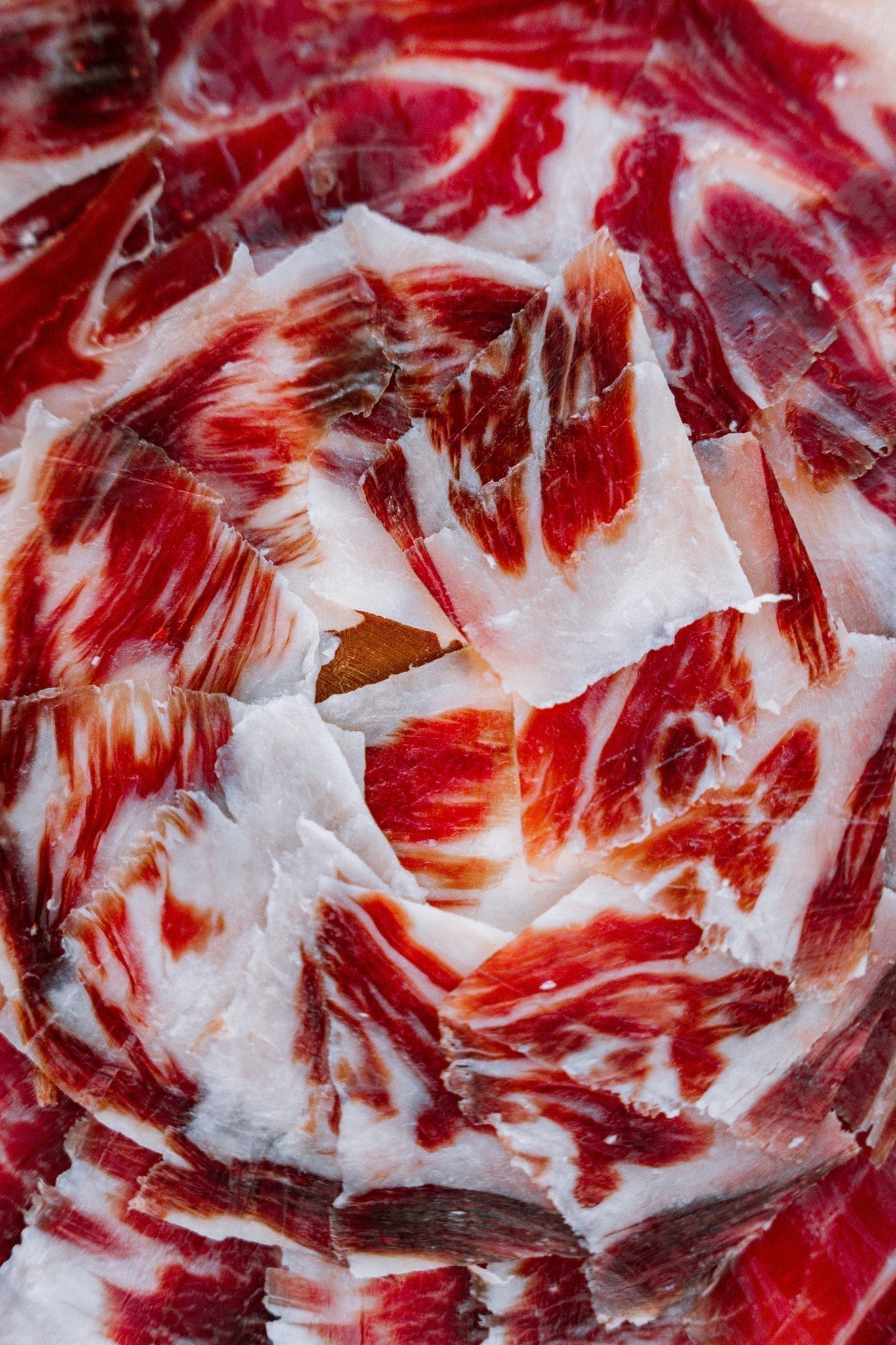
Our preference for the knife therefore rests on what we observe and what we like: an irregular slice, fat that stays supple, a piece you follow over time. It is a craft choice, not an established fact, and we will not present it as anything else.
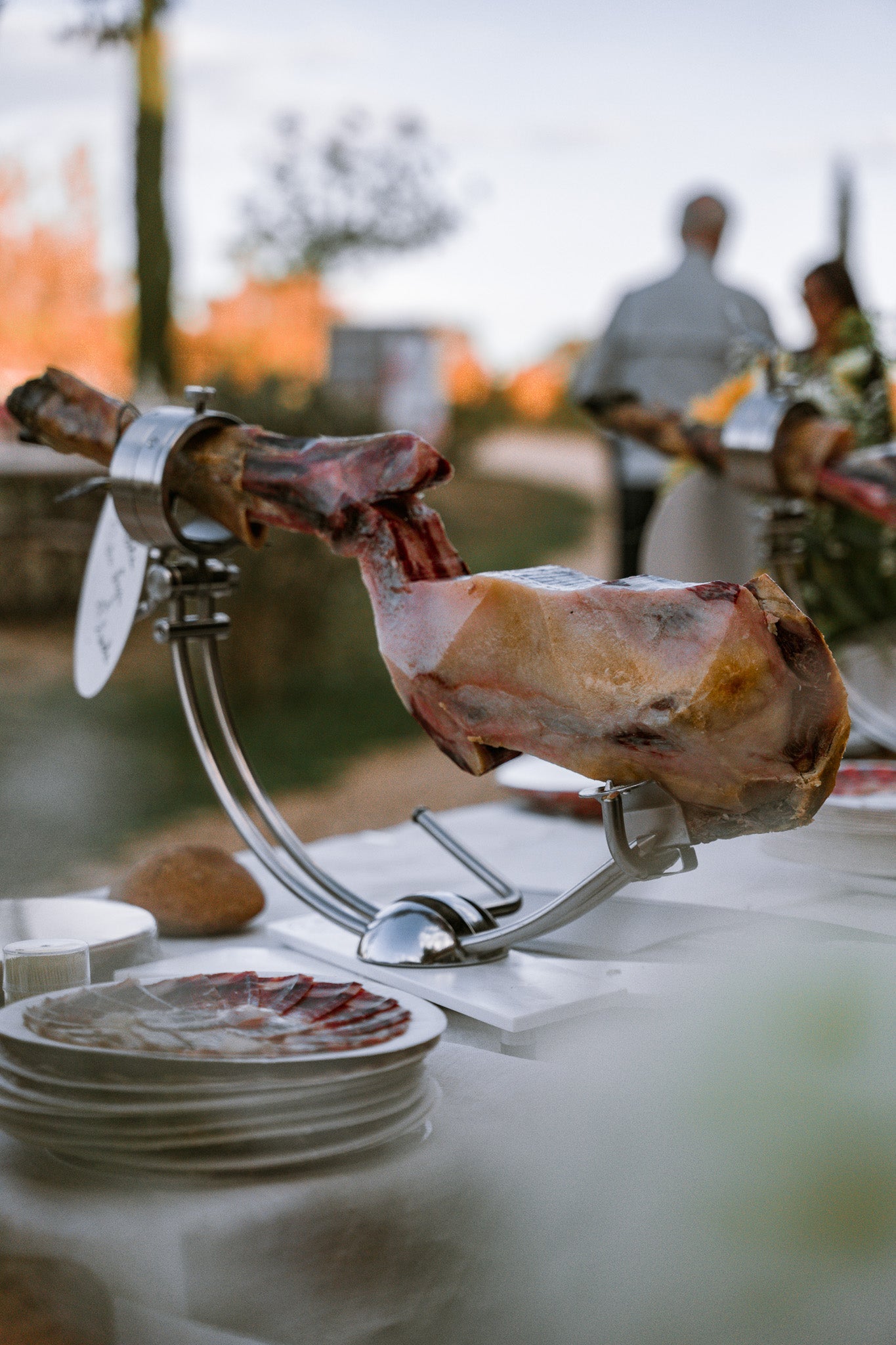
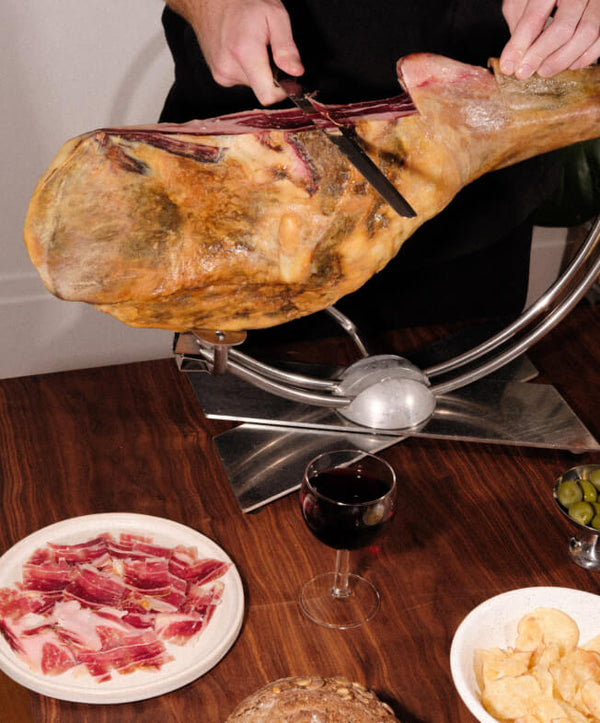
The decree describes a workstation before it describes a gesture, and the order is not accidental. The criteria in that same module require the tools to be in place before starting — knives, steel, tongs, stand, protective glove, cloths, waste container — and the blades to have been sharpened beforehand. A professional does not sharpen during service. He sharpens before.
The stand matters as much as the knife. It is what allows the rotation the text calls for, and therefore the full use of the piece. A piece you cannot turn is a piece you waste. We go through the choice of equipment in our buying guide.
The last part of the module comes as a surprise: it is given over entirely to hygiene and traceability. Packing leftovers in food-safe containers, labelling them, disinfecting the tools. It is not the showy part of the craft. It is the part that separates a professional from a gifted amateur.
Javier opens and carves one of our pieces. Watch the order in which he lays out his tools before touching the ham, and the moment he sharpens: it is before, never during.
Conclusion
A new diploma, an old craft
Spain took four years to write down what this craft demands, and stopped just short of closing it. That is coherent: you can assess a cutting angle and a hygiene protocol, you cannot assess by decree what a cortador smells when he pushes a needle into a piece. The text pins down what can be checked and leaves the rest to the trade.
- Be wary of the word “certified”. Ask by whom. A state diploma and an association title do not say the same thing.
- Look at the workstation before the slice. Stable stand, blades sharpened in advance, clean surface: three seconds is enough.
- For your own piece, choose the timescale first. A ham you finish in a month is not opened like one meant to last six.
Frequently asked questions
Do you need a diploma to be a maestro cortador in Spain?
No. Real Decreto 84/2026 creates a diploma, and its first additional provision states expressly that it regulates no profession. There is no professional body, no register, no requirement.
How thick should a slice be?
No text sets a thickness for serving. The only figure written down in Spain, 1 to 1.5 mm, concerns the preparation of samples for a tasting panel. The rest is a matter of hand and piece.
At what temperature should Iberian ham be served?
No official source publishes a serving range. The only institutional reference is a tasting protocol that brings samples to 20–25 °C for 20 to 30 minutes. Keep the principle rather than the number: ham that is too cold will not slice thin, ham that is too warm gives up its fat.
Which face do you start on?
The text does not impose one. The choice depends on how long you will take to finish the piece. We explain it in the article on the parts of the ham.
Does the Spanish championship award an official title?
No. It has been run since 2007 by a private association founded in 2006, whose membership is open to anyone. The title it awards is real within the trade, but it carries no administrative standing.
Sources
- Real Decreto 84/2026 of 11 February 2026: creation of the course, modules 5158 and 5159. Consulted 26 August 2026.
- Real Decreto 546/2023 of 27 June 2023: vocational qualification HOT818_2, annex XV.
- Training programme HOTR0014: Spanish public employment service, December 2022.
- Methodological guide to the sensory evaluation of cured ham and shoulder: IRTA, with support from INIA.
- Rules of the national carving contest at Gines (Seville): scoring and maximum duration.
- Our own observations, while filming a carving session with the cortador we work with.
Read next
Written by

Valentin & Pablo
Founders of LOLO Jamón
We import and distribute Iberian ham and charcuterie. We visit the farm every season and select the pieces ourselves.
A whole piece, to open at home
Bellota and cebo de campo jamones and paletas, cured 28 to 48 months.
See the whole piecesShipped from Spain · free shipping over €89.90

Leave a comment
This site is protected by hCaptcha and the hCaptcha Privacy Policy and Terms of Service apply.