


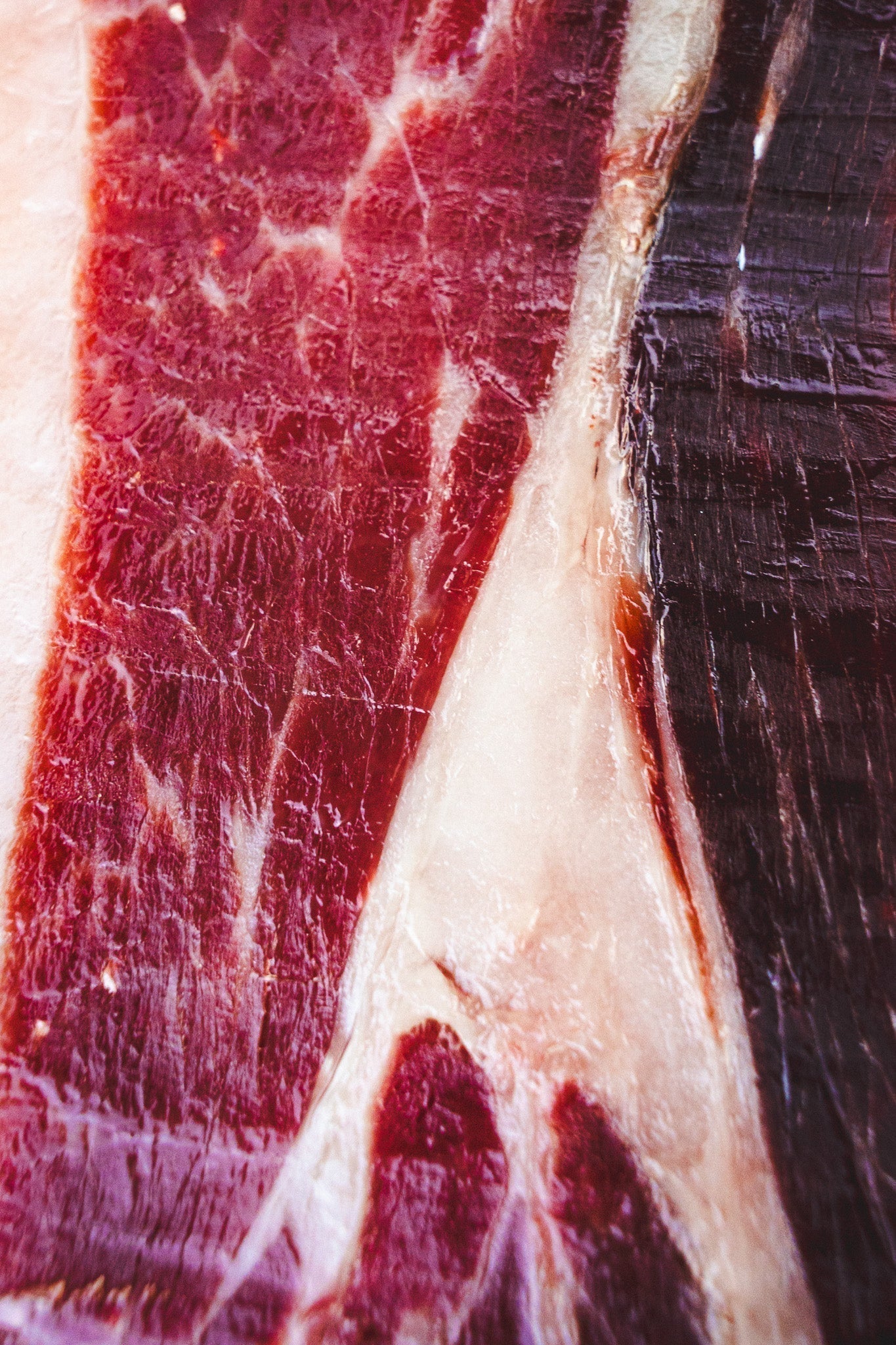
The parts of an Iberian jamón and paleta, zone by zone
A whole piece does not taste the same from one end to the other. Depending on where the knife passes, the slice comes out fatty or lean, tender or dry, mild or distinctly salty. Here are the six zones, what sets them apart, and which one to start with.
The essentials
The maza is the fleshiest face, the one with the most marbling. The babilla, directly opposite, is the leanest and the driest. Almost everything else follows from those two faces.
- There is no official nomenclature for these zones. A Spanish decree of February 2026 names them for the first time, but calls them customary terms.
- Start on the maza if the piece will be eaten quickly, on the babilla if it has to last.
- On a paleta it is the shoulder blade that dictates the carving, and it makes the job harder.
- No published source gives the bone-to-meat ratio of a piece. You will find no percentage here.
Where this information comes from
The names of the zones and the assessment criteria come from Real Decreto 84/2026, published in the Boletín Oficial del Estado on 11 February 2026, which creates the Spanish qualification for master carvers. The definitions of the pieces and the minimum weights come from Real Decreto 4/2014, articles 2 and 12. The carving rule comes from the manual of the Escuela Europea de Cortadores de Jamón.
The rest comes from our own practice: we carve whole pieces all year round. We flag it every time, because on this particular subject the line between the official text and the trade’s own usage runs straight through the middle of the article.
What the decree names, and what it does not define
Until 2026, no Spanish text named the zones of a ham. Not the quality standard for Iberian products, not the specifications of the protected designations of origin. The vocabulary passed from carver to carver, with regional variants nobody had ever settled.
The February 2026 decree changes that halfway. It requires the future qualified carver to identify “the most common names” for the parts of the piece, and lists them: maza, babilla, punta, jarrete, contramaza, caña and pezuña. It also names the bones the knife will meet. But it defines none of these zones, and the word “common” says exactly what they are: trade usage, not a standard.
The six zones
| Zone | Where it sits | What it gives |
|---|---|---|
| Maza | Rear face of the thigh, bone far from the surface | The fleshiest and the most marbled |
| Babilla | Front face, between the femur and the hip bone | The leanest and the driest, often saltier |
| Contramaza | Narrow band extending the maza | Little meat, more advanced curing |
| Punta | The end opposite the trotter, at hip level | Held to be the fattiest and most aromatic |
| Jarrete | Between the maza and the caña, around the tibia | Fibrous and sinewy, intense flavour |
| Caña | The narrowest part, next to the trotter | Very little meat, diced into taquitos |
Zone names: Real Decreto 84/2026, module 5158. Positions and profiles: trade usage and our own carving practice.
The two faces: maza and babilla
The maza is the rear face of the thigh, the one carrying the whole mass of the hind leg muscles. The femur sits far from the surface, which leaves a considerable thickness of meat. It is the juiciest zone, the best marbled, and the slowest to dry. The 2026 decree even makes it a visual quality criterion: on a good piece, the maza is “even and wrapped in fat”.
The babilla is the opposite face, at the front of the thigh. The femur and the hip bone come close to the surface, the layer of meat is thin, and the fat cover lighter. The same decree describes it as “lightly wrapped in fat”, in contrast to the maza. It therefore loses its water faster, concentrates in salt, and yields shorter, drier slices.
This is not a flaw, it is geometry. The meat sits closer to the bone and is less protected, so it cures faster. Plenty of people who like long-cured ham prefer this zone precisely for that: it is franker and more concentrated.
Three things you often read that are wrong
“The babilla is the most melting part.” It is the other way round. It is the leaner and drier of the two faces, and no source, from the decree to the carving manuals, says otherwise.
“The contramaza is also called the cadera.” No: cadera is another name for the punta. The 2026 decree writes “the lower area of the punta, or cadera”.
“These zones are officially defined.” They have been officially named since 2026, which is not the same thing. No text sets their boundaries.
The extremities
The punta sits at the very top of the piece, at the end opposite the trotter, at hip level. The trade holds it to be the fattiest and most aromatic zone, and many carvers save it for the end of a service. We share that view, but we give it for what it is: a tasting observation, not a measurement.
At the other end, the jarrete and the caña. The meat there is threaded with tendons and fibres, which makes a thin slice impossible. This is where taquitos come from, small dice to cook with or to nibble, and the bone left afterwards makes an excellent stock.
As for the contramaza, it is the zone whose name moves around the most. Some carvers see it as a narrow band extending the maza on the far side of the hip bone; others use the word as a plain synonym for babilla. The decree lists both terms together without choosing between them. So do not be surprised to find two definitions depending on the source: the ambiguity is real, and it is not your doing.
Which face to start on
No text imposes an answer. The 2026 decree only asks the future master carver to know how to choose between the maza and the babilla, which amounts to acknowledging that the choice is a judgement.
The rule taught in carving schools is simple. For a piece that will go quickly, a family meal or an event, start on the maza: it is the most generous, it gives the best slices, and they may as well be served. For a piece you will open and eat over several months, start on the babilla.
The reason fits in one sentence: the babilla dries faster. Saving it for last means finding it hard three months in. The maza, being fattier, copes with waiting far better.
That said, part of the trade disputes the rule and argues that drying depends above all on how the piece is looked after: putting the fat cover back after each service, covering it, and carving regularly. Both positions hold up. We follow the rule, and we look after the piece anyway. The detail on equipment and storage is in our buying guide and in our article on storing a ham after opening.
And on a paleta
The same names circulate, but no text mentions them for the paleta: there we are entirely in trade usage. Carvers speak of maza and contramaza on the same principles, with the same logic of a fleshy face and a lean one.
What really changes is the bone. A jamón is built around long, aligned bones. A paleta articulates on the shoulder blade, a wide flat bone crossed by a raised ridge, the scapular spine, which cuts the carving area in two. You do not go around it: you follow its shape, mark the wall of the bone, then recover the meat lodged in the hollow separately. That is what makes the paleta more technical and its yield lower.
Everything that separates the two pieces beyond anatomy — weight, curing time, the profile on the palate — is covered in our jamón and paleta comparison.
The weights, and what we cannot tell you
Our whole jamones weigh 7 to 8 kg and our paletas 4 to 5 kg. The regulation, for its part, sets floors: a 100 % Iberian jamón cannot be sold as such below 5.75 kg, a 100 % Iberian paleta below 3.7 kg. These are labelling thresholds, not average weights.
You will, on the other hand, read bone and yield percentages everywhere. We will give none. We looked for a published source on the bone-to-meat ratio of a jamón or a paleta, in official texts, in the designation specifications and in the technical literature. There is none. The only figures in circulation come from trade forums where they are given from memory, and contradicted in the same thread.
What is true and observable: a paleta holds proportionally more bone and sinew for less meat than a jamón. You will get fewer slices for the same weight. How many fewer, nobody knows with the precision a percentage implies.
Conclusion
One piece, six flavours
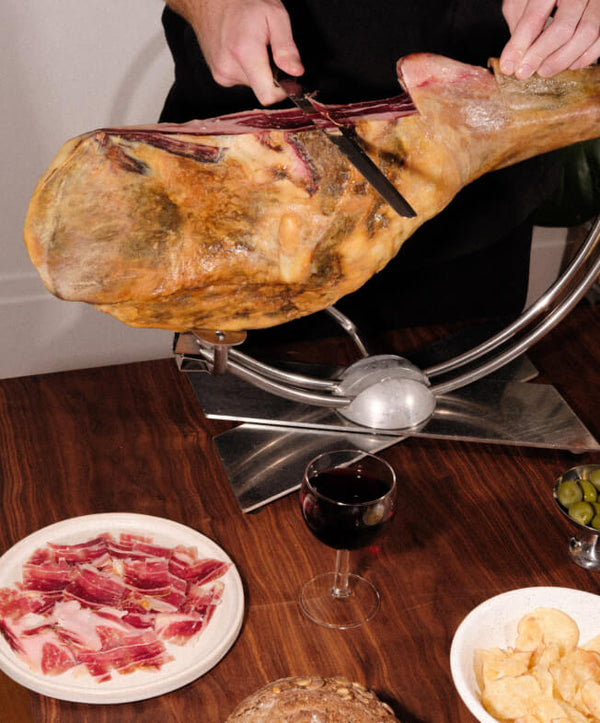
This is why a whole piece does not really compare with a pack. Over several months it gives, in turn, lean concentrated slices, then wide melting ones, then frankly fatty ones, then dice to cook with. The same animal, the same leg, and four different products.
If you are starting your first piece, keep only this: find the widest face, that is the maza. Decide whether the piece has to last. And carve regularly, which is what preserves it best.
Frequently asked questions
Which is the best part of an Iberian ham?
The maza is the fleshiest and the best marbled, and it is the one most carvers serve first. But the punta is more aromatic, and the babilla more concentrated. There is no best part; there are different profiles within the same piece.
Is the babilla the fattiest part?
No, the opposite. The babilla is the front face, where the femur and the hip bone come close to the surface: less meat, less fat cover, faster drying. The royal decree of February 2026 describes it as “lightly wrapped in fat”, against a maza that is “wrapped” in it.
Which face should you start carving?
The maza if the piece will be eaten quickly, the babilla if it has to last several months. The babilla dries faster: saving it for last risks finding it hard. No official text imposes this; it is the rule taught in carving schools.
What do you do with the shank and the bone?
The jarrete and the caña are too fibrous for thin slices. They are cut into small dice, taquitos, to cook with or to serve with drinks. The bone left afterwards makes a remarkable stock for soup or pulses.
How much does a whole Iberian ham weigh?
Our whole jamones weigh 7 to 8 kg and our paletas 4 to 5 kg. Spanish regulation sets a floor, not an average: 5.75 kg for a 100 % Iberian jamón and 3.7 kg for a 100 % Iberian paleta.
Sources
- Real Decreto 84/2026, of 11 February 2026, Boletín Oficial del Estado: modules 5158 and 5159 of the specialisation course in carving and tasting cured jamón and paleta. Zone names, bone names and visual assessment criteria.
- Real Decreto 4/2014, articles 2 and 12: anatomical definition of the jamón and the paleta, minimum weights and curing times.
- Manual del cortador, Escuela Europea de Cortadores de Jamón: carving order and choice of the starting face.
- Zone positions, tasting profiles and carving practice: our daily work. No bone ratio and no yield figure has been published to date; we therefore put forward none.
Read next
Written by

Valentin & Pablo
Founders of LOLO Jamón
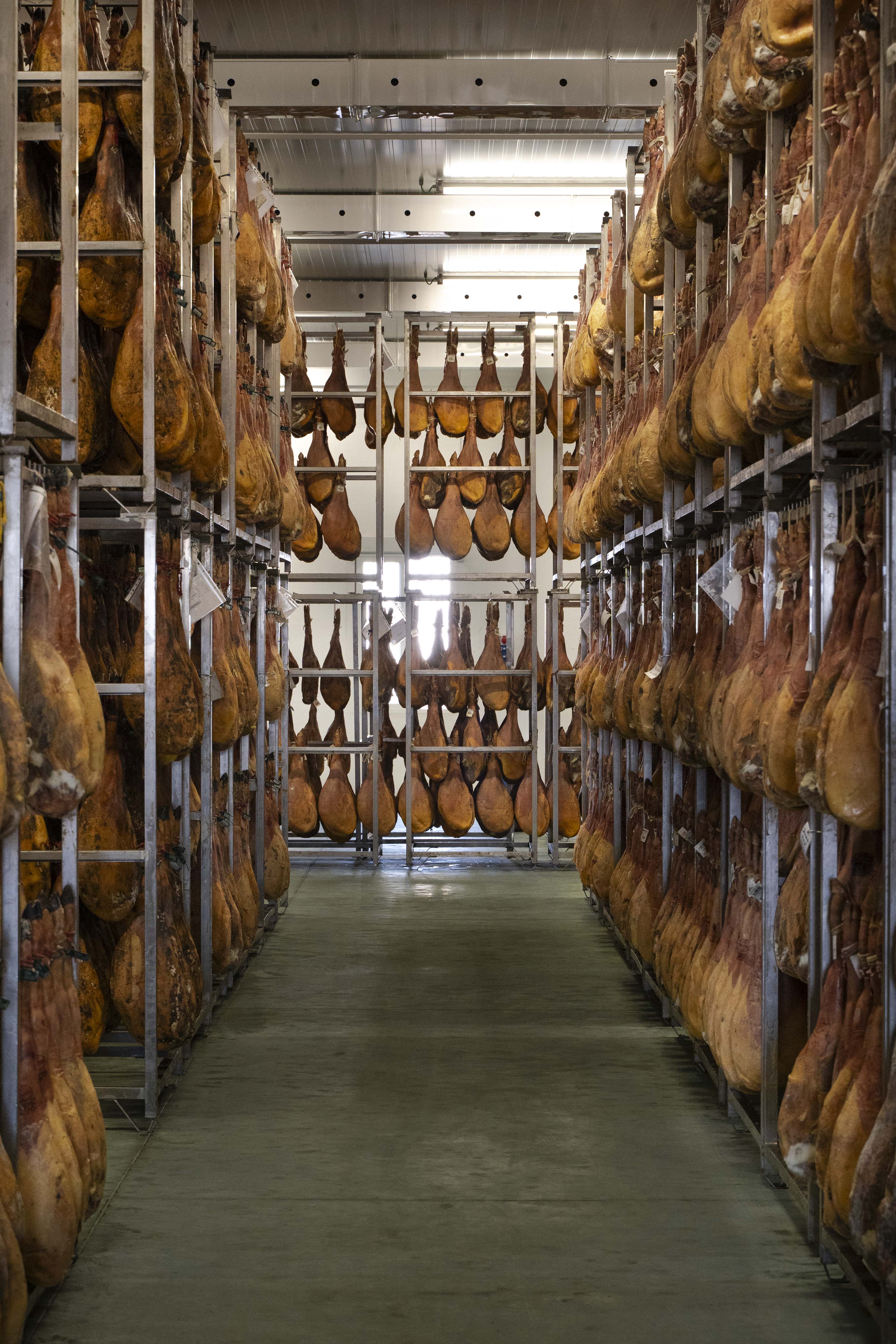
We select our pieces in the drying cellars of the Salamanca dehesa, and we carve them all year round.
One whole piece, six zones to discover
Jamones of 7 to 8 kg and paletas of 4 to 5 kg, bellota or cebo de campo, from the Salamanca dehesa.
See the whole piecesShipped from Spain · free shipping over €89.90


Leave a comment
This site is protected by hCaptcha and the hCaptcha Privacy Policy and Terms of Service apply.