


White specks on ham: crystals, salt or mould?
You open a plate of jamón and see small white specks on the slice. First reaction: salt? mould? Neither. And contrary to what the trade keeps repeating, their presence is not a medal — the only official text that mentions them puts them on both sides of the scale, among the good signs and among the defects.
The essentials
A few white specks on the slice are normal and expected in a long-cured ham. Many white specks are a defect. No text says where the line falls.
- They are amino acid crystals, formed during curing. Neither salt nor mould.
- Spanish Royal Decree 84/2026 names them twice: “a few white specks” among the marks of a good ham, “excessive white specks” among the defects. With no numeric threshold.
- The word “tyrosine” appears in no regulatory text. It is a chemist’s word, not a legal one.
- Nothing shows that their presence improves flavour. For trained tasters it is not a criterion that tells hams apart.
- Their absence means nothing. Freezing the green ham, the pH of the meat and the way drying is run all change how they appear.
Where this information comes from
This subject is overrun with claims copied from shop to shop, so we went back to the texts instead. The regulatory side comes from Spanish Royal Decree 84/2026, read article by article, and from the Iberian ham quality standard. The scientific work is listed at the foot of the page, with links. What we observe when we open pieces we write in the first person: it is an observation, not a measurement. And we sell Iberian ham: you should know that before reading an article about quality.
What you see, and what it is not
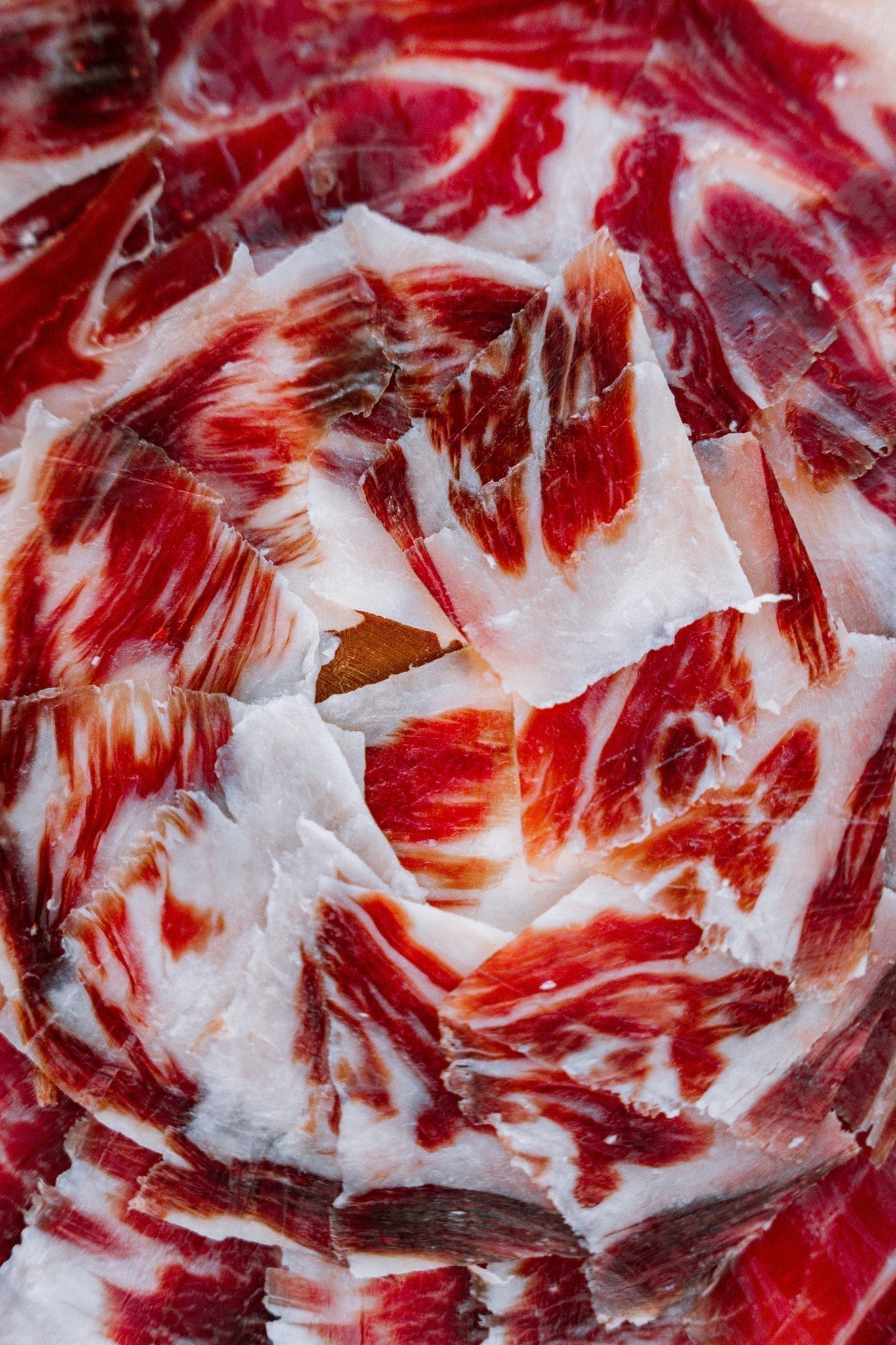
They are small specks, white to ivory white, opaque, standing out sharply against the red of the meat. They are not evenly spread: whole areas carry them and neighbouring slices carry none. On our own pieces, the most visible ones measure in fractions of a millimetre and rarely exceed the size of a pinhead.
They are in the meat, not on it. That is the most useful distinction in this whole article, and it needs no equipment: a surface deposit comes off, a crystal formed inside the muscle appears when you slice.
Where exactly? You often read “in the maza and the babilla”. Those two words name the two opposite faces of the piece: saying that says nothing. What is true is that they form within the muscle mass, and that the driest, saltiest areas do not behave like the fatty ones — we have described the zones of the piece elsewhere.
What it is not: that is the real question when you open a plate, and the one nobody answers plainly. Four different things can produce white on a ham, and they are not equivalent.
The point to remember: salt dissolves, mould wipes off, fat is translucent, a crystal resists. You need nothing else to decide.
| What you see | Where it is | What it is |
|---|---|---|
| Opaque white specks hard under the tooth | In the meat, revealed by the cut | Amino acid crystals. Normal. |
| Matt white veil even, powdery | On the cut face, appearing after opening | A film that forms in the air. Harmless; it comes off. |
| Cottony fuzz raised, sometimes greenish | On the outside of the piece, on rind or fat | Mould. It wipes off with a cloth and does not penetrate. |
| Translucent white soft, greasy to the touch | Between the fibres, in the veins | Infiltrated fat. That is what you want, not a defect. |
Royal Decree 84/2026 draws the same distinctions: it lists “excessive white specks”, “white veil” and “salt precipitates” separately. Three different defects, three different causes.
The tests the internet recommends, and why we do not repeat them
Three protocols come up again and again. Holding the crystal over an open flame, citing a melting point of 318 °C; dissolving it in hot vinegar; or dropping it into a glass of water to see whether it sinks. We looked: none of these tests has ever been published or evaluated anywhere. They circulate between shops.
The reasoning is not absurd: these crystals dissolve poorly in water. But a ham crystal is not pure — it is wrapped in fat and fibre — and nothing guarantees that what you see in your glass is what you think it is.
The only test that holds is the one in the table above: where the white sits, and whether it comes off.
The only official text on the subject puts them on both sides
This is the most interesting fact about the subject, and nobody cites it. Royal Decree 84/2026, which last February created the Spanish qualification in ham carving and tasting, describes in its module 5159 what a professional must be able to recognise by eye. White specks appear twice.
First on the good side: among the criteria that characterise a quality piece, alongside even marbling, the text cites “a few white specks” — algunas pintas blancas. Then on the bad side: among the defects a professional must be able to identify, alongside case hardening, mites and internal oxidation, it cites “excessive white specks” — pintas blancas en exceso.
And it gives no threshold. No count, no area, no size. The text defers entirely to the trained eye. That is frustrating, and it is probably honest: the line between “a few” and “excessive” cannot be put in figures.
One more thing is worth noting: the word tyrosine appears neither in that decree nor in the Iberian ham quality standard. No Spanish regulation names the molecule. It is a chemist’s word the trade adopted because it sounds serious, and it describes one stage of curing.
What is actually known about these crystals
They are amino acid crystals, and that has been known for a long time: analysis of dry-cured hams showed that tyrosine clearly dominates their composition. It is not alone — a very close molecule comes second.
Why this one and not another? A question of dissolution. Both are released together in a piece that has lost a third of its water; one dissolves in the water that remains, the other does not, and that is the one that forms the crystal.
The mechanism itself is not in dispute: during curing, the enzymes cut the proteins down to free amino acids, the same work that builds the flavour of the ham. Here, on the other hand, is the honest limit: no direct analysis of the crystal itself has ever been published. The identification rests on measurements, not on observing the crystal. It is solid, but indirect.
“Crystals, therefore quality”: what the claim is worth
It is the trade’s universal shortcut. It holds a grain of truth — curing needs time to get that far. The rest does not survive a read of the sources.
Hams cured for 6, 9, 12 and 16 months were described by 109 consumers and by trained tasters. “White spots” were indeed mentioned: by 19.3 % of consumers. But they do not separate a sixteen-month ham from a six-month one.
More awkward for the commercial story: in published work crystals are not a goal but an incidence to be modelled and reduced. In 2021 a higher incidence was found in hams dried at 20 °C and in those that had lost 40 % of their weight.
The absence of crystals proves nothing either. In 1994 it was shown that freezing the green ham, the pH of the meat and the storage temperature all change the formation of the crystals. A ham may have cured for four years and show few.
| What you read everywhere | What the publications say | Status |
|---|---|---|
| “They appear after 20 months” or 24, or 36, depending on the site | No publication gives a time threshold. The studies describe a variable incidence, not a date. | Not established |
| “Their abundance is proportional to curing time” | Across four curing times compared, it is not a criterion that separates the hams. | Not established |
| “They improve the flavour” | The crystals have no flavour of their own. No study attributes any gain in taste to their presence. | False |
| “Their absence betrays accelerated curing” | Freezing, meat pH and the way drying is run change how they appear at equal curing time. | False |
| “They are tyrosine crystals” | Tyrosine dominates, a very close molecule follows. No direct analysis of the crystal itself has ever been published. | True, but indirect |
Each line here points to a dated source, listed at the end of the article.
What to do about it
If you see a few: nothing. That is the normal behaviour of a long-cured piece. Do not scrape them, do not rinse them.
Slice thin. It is the only move that changes anything: a thick slice from a crystal-rich area feels grainy, a thin one does not. The rest is a matter of carving, and we have given it a whole article.
Serve at around 21 to 24 °C. No official standard sets a serving temperature for ham. The fat should look translucent and glossy — that is the real criterion.
If you see none: that says nothing about the age of the piece. Look instead at the seal, the category and the curing time the seller states — our buying guide.
If the white appeared after opening and is even: that is the veil, not a crystal. It comes off, and mostly it tells you the cut face has dried out. Here is how to protect a started piece.
Conclusion
A few yes, many no
The subject could have been settled with one reassuring line — “it is not mould” — and that would be true. But the shortcut that usually follows, “so it is a good sign”, does not survive a read of the sources. The Spanish text that trains professionals took a finer and fairer position: a few white specks are the mark of a good ham, many are a defect.
- Look first at where the white is. In the meat, it is a crystal. On the cut face or on the rind, it is something else, and it comes off.
- Do not judge a ham on it. Neither on their presence nor on their absence. The category, the seal and the curing time say far more.
- Slice thin, serve tempered, and light no flames.
Frequently asked questions
Are the white specks on ham dangerous?
No. They are amino acid crystals formed naturally during curing, out of the proteins of the meat itself. They are perfectly edible. They are neither added salt nor mould.
How do I tell a crystal from mould?
By where it is. The crystal is in the meat and only appears when you slice: it cannot be removed. Mould sits on the outside of the piece, on the rind or the fat, it is cottony and raised, and it wipes off with a cloth.
Is it really tyrosine?
Mostly, yes. Analysis of these crystals shows that tyrosine dominates their composition, followed by a very close molecule. But no direct analysis of the crystal itself has ever been published: the identification is solid, and it remains indirect.
Does their presence guarantee a quality ham?
No, and the only official text that mentions them says so in its own way: Spanish Royal Decree 84/2026 places “a few white specks” among the marks of a good ham and “excessive white specks” among the defects, without giving any threshold.
My ham has none — is that a bad sign?
No. Freezing the green ham, the pH of the meat and the way drying is run all change how they appear at equal curing time. A piece may be four years old and show few.
Sources
- Royal Decree 84/2026 of 11 February 2026: module 5159, assessment criteria for learning outcomes 5 and 6 — algunas pintas blancas and pintas blancas en exceso. Accessed 30 August 2026.
- Iberian ham quality standard, Royal Decree 4/2014: no mention of crystals or of tyrosine.
- Arnau, Guerrero, Hortós & García-Regueiro, Journal of the Science of Food and Agriculture, 1996: composition of the white film and white crystals of dry-cured hams.
- Arnau, Gou & Guerrero, Journal of the Science of Food and Agriculture, 1994: effects of freezing, meat pH and storage temperature.
- Do, Chua, Kumar et al., RSC Advances, 2020: water solubility of amino acids at 25 °C.
- Guàrdia, Aguiar, Claret, Arnau & Guerrero, Food Quality and Preference, 2010: free-choice sensory profiling of hams cured 6 to 16 months.
- Coll-Brasas, Gou, Arnau, Olmos & Fulladosa, Meat Science, 2021: incidence of tyrosine precipitates according to drying conditions.
- Krvavica et al., Italian Journal of Animal Science, 2008: effect of desalting on the white crystals of Istrian ham.
- Tansman, Kindstedt & Hughes, Dairy Science & Technology, 2015: X-ray diffraction of cheese crystals.
Read next
Written by

Valentin & Pablo
Founders of LOLO Jamón
We import and distribute Iberian ham and charcuterie. We visit the farm every season and select the pieces ourselves.
100 % Iberian acorn-fed
Hams, shoulders and plates of bellota pata negra, cured for 32 to 48 months.
See the bellota selectionShipping to France within 48 h. Secure payment.


Leave a comment
This site is protected by hCaptcha and the hCaptcha Privacy Policy and Terms of Service apply.