


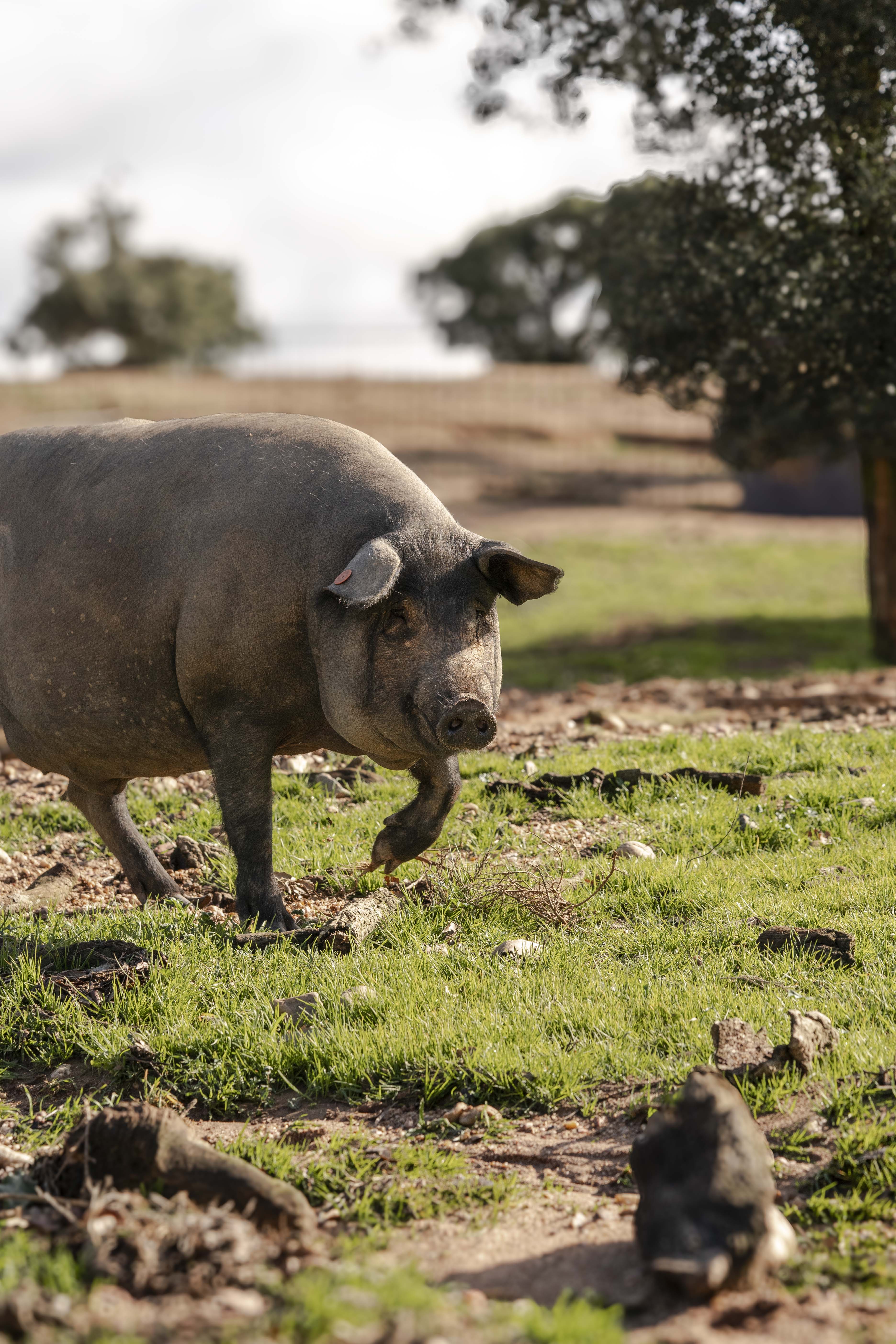
What does the Ibérico pig eat, and why does it change the taste of the ham?
Not every Ibérico pig eats the same thing, and that is what explains the price gap between two hams that look alike. A pig destined for an acorn-fed ham switches diet in autumn: it goes out into the dehesa and lives on the acorns that have fallen. A grain-fed pig raised indoors never sees one. Between the two sits the free-range grain-fed pig, outdoors all year, picking up a few acorns that nobody counts.
The short answer
For a ham to carry the “de bellota” designation, the pig has to put on 46 kg out in the dehesa, over more than 60 days, with no feed brought to it. That is a legal requirement, not a selling point.
- The dates are set: animals enter the dehesa between 1 October and 15 December, and are slaughtered between 15 December and 31 March.
- They go in at an average of 92 to 115 kg. The 46 kg they must gain works out at roughly 600 kg of acorns per animal across the season.
- Stocking density is capped: from 0.25 animals per hectare on a lightly wooded dehesa to 1.25 where oaks cover more than a third of the plot.
- Acorns leave a measurable trace: the fat of an acorn-fed pig contains at least 54% oleic acid. That is why it melts so quickly on a warm plate.
Where these figures come from
The periods, weights and densities quoted here come from Royal Decree 4/2014, the Spanish standard that governs the whole Ibérico sector. We reread the consolidated text published in the Boletín Oficial del Estado on 23 August 2026: articles 3, 6, 7, 8, 9 and 12, plus the annex. The figures on acorn intake, weight gain and fat composition come from Ganadería, published by the Spanish Ministry of Agriculture.
The rest comes from what we see on the ground. We select our pieces in the drying cellars of the Salamanca dehesa, and we filmed a full montanera season for our documentary Viva España.
One point of honesty: we sell the products we are writing about, both acorn-fed and free-range grain-fed. You should know that as you read. It is also why we name no brands and rank no one. Where we could not find a source for a figure, we removed it rather than round it.
Two seasons, three ways of raising a pig
The year of an acorn-fed pig falls into two halves. Through spring and summer the dehesa gives little: the grass is dry, the oaks have no fruit yet, and the animals go out mainly in the cooler hours. They are fed on cereals and pulses during that time. Ours are given a mix blended on the farm, based on wheat, barley, almonds and sunflower seed. The raw materials are bought in; the recipe is ours.
The first acorns drop in late September and the animals’ behaviour changes noticeably. They walk for much of the day and pick out the ripest fruit. We watched it during filming: they really do select. This season, the montanera, is what determines the composition of the fat and the legal grade of the piece.
Only animals that go through a montanera produce a ham with a black or red seal. A free-range grain-fed pig stays on its plot all year, on its ration of cereals plus whatever it finds. It will eat acorns if the plot has them, but nothing requires it and nothing verifies it. A grain-fed pig raised indoors has no access at all. Confusing these three is the most common mistake at the point of purchase.
| Rearing | What it eats | What it produces |
|---|---|---|
| Acorn-fed, summer dry dehesa | Cereals and pulses, sparse grass, roots | The animal grows and builds muscle |
| Acorn-fed, montanera entry 1 Oct to 15 Dec | Fallen acorns, fresh grass, roots, mushrooms | 46 kg gained at least, marbled fat that melts low |
| Free-range grain-fed outdoors all year | Cereals and pulses, a few acorns in season | A steadier flavour, fat that melts less readily |
| Grain-fed raised indoors | Cereals and pulses only | No acorns, no walking, little marbling |
What the law requires before you can write “bellota”
The designation is not free to use. Article 6 of the decree sets out four things an inspector can check: the entry and slaughter dates, the average weight of the batch on arrival, the weight gained and the time spent outdoors, and the number of animals allowed per hectare. Fail any one of them and the piece falls out of the category.
| Requirement | Figure | Article |
|---|---|---|
| Entry into the dehesa | 1 October to 15 December | art. 6.3 |
| Slaughter | 15 December to 31 March | art. 6.3 |
| Average batch weight on entry | Between 92 and 115 kg | art. 6.4 |
| Minimum weight gain | 46 kg, over more than 60 days | art. 6.4 |
| Animals per hectare | 0.25 to 1.25 depending on tree cover | annex |
| Free-range grain-fed | 100 m² per animal, slaughter at 12 months minimum | art. 7 |
| Grain-fed | 2 m² per animal, slaughter at 10 months minimum | art. 8 |
Space requirements apply to animals over 110 kg live weight. Royal Decree 4/2014, consolidated text, consulted 23 August 2026.
The last two rows say the most: 100 m² per animal for free-range grain-fed, against 2 m² for grain-fed. A ratio of one to fifty. Space is what decides whether the animal walks, and walking is what drives fat into the muscle. That figure appears on no label.
What to check before buying
A piece sold as “acorn-fed” without a black or red seal is bound by none of it: not the 46 kg, not the 60 days, not the dates. The seal is the only element checked by an independent inspection body. It counts for more than the title on the product page.
Three things you often read, and what the decree says
“An acorn-fed pig eats nothing but acorns.” The decree describes fattening on the natural resources of the dehesa, not on acorns alone. The animal also eats fresh grass, roots and mushrooms. That variety matters: it gives the fat aromas a diet of acorns alone would not produce.
“The montanera starts in September.” It starts on 1 October at the earliest, and the animals must be in by 15 December. You will often see “September to February”: both ends are wrong.
“Forty kilos gained is already acorn-fed.” The minimum is 46 kg. Below that, the designation is refused. A range of 40 to 60 kg is sometimes quoted: the figure is wrong.
To picture what that takes: around 600 kg of whole acorns per animal across the season, according to the Spanish Ministry of Agriculture. Spread over sixty days, that comes to roughly ten kilos a day. A pig then gains 500 to 600 g daily in an average montanera, and up to 800 g or a kilo in the good years.
What it changes in the ham
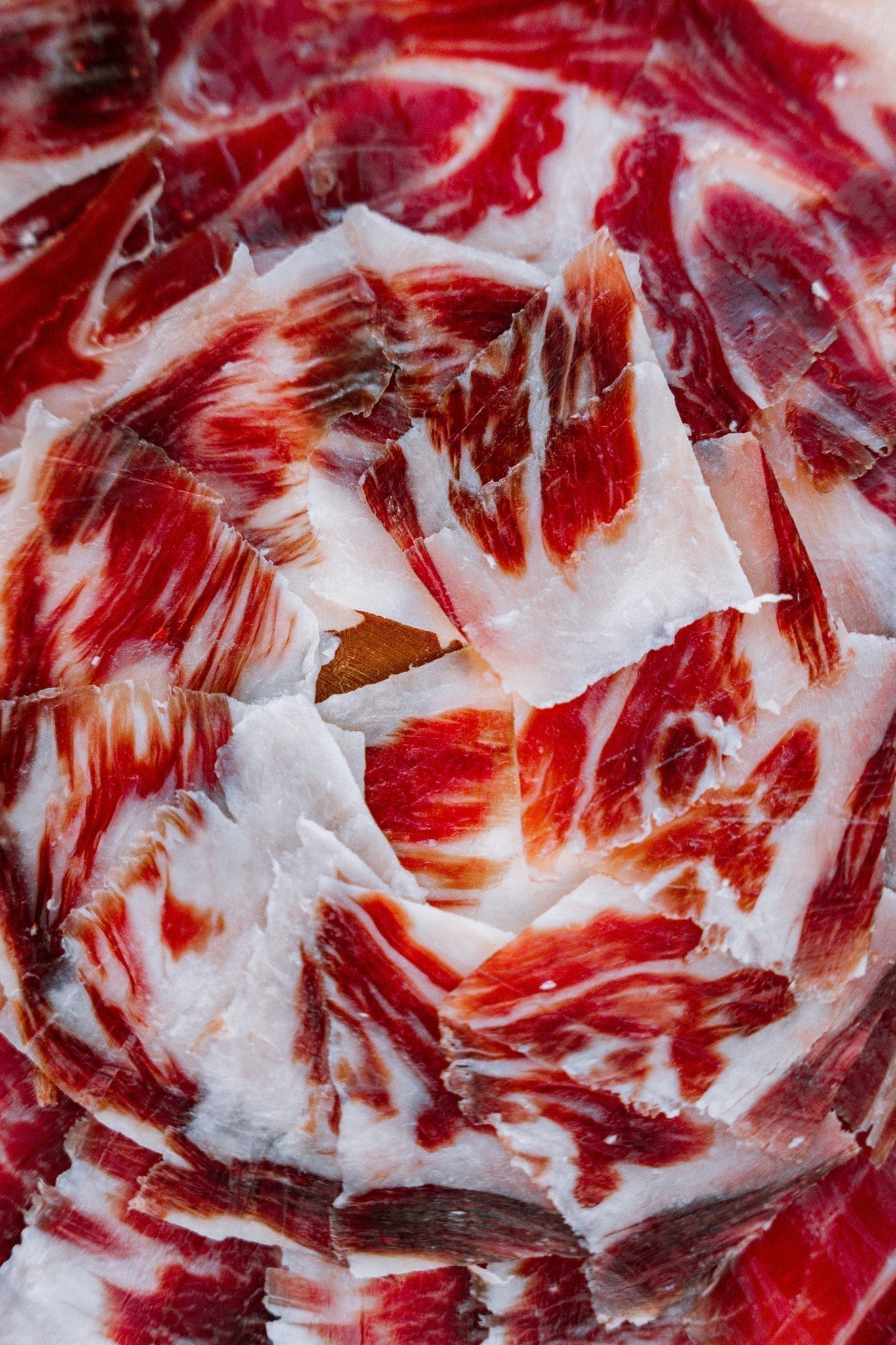
Oleic acid dominates the fat of the acorn, just as it dominates that of olive oil. The pig stores it as it is, in its own fat. In an acorn-fed animal, that fat contains at least 54% oleic acid. Fat like that melts at a lower temperature than ordinary fat, and the result is visible on the plate: laid on a warm plate, a slice of acorn-fed ham turns translucent within seconds, while a grain-fed slice stays matte far longer.
Walking counts as much as the diet. An animal that ranges across the dehesa to find its food does not build the same muscle as one eating at a trough: the fat settles between the fibres instead of piling up in a layer. That marbling is what gives the melting texture, and it is why the decree caps the number of animals per hectare. No space, no walking. No walking, no marbling.
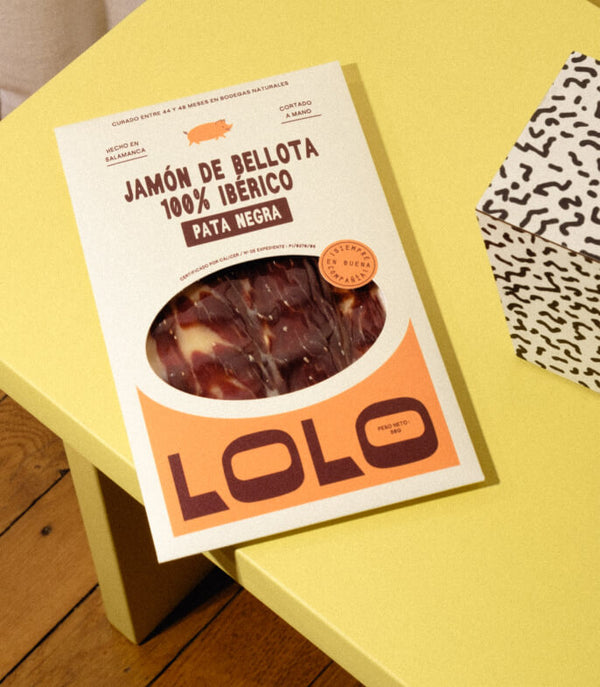
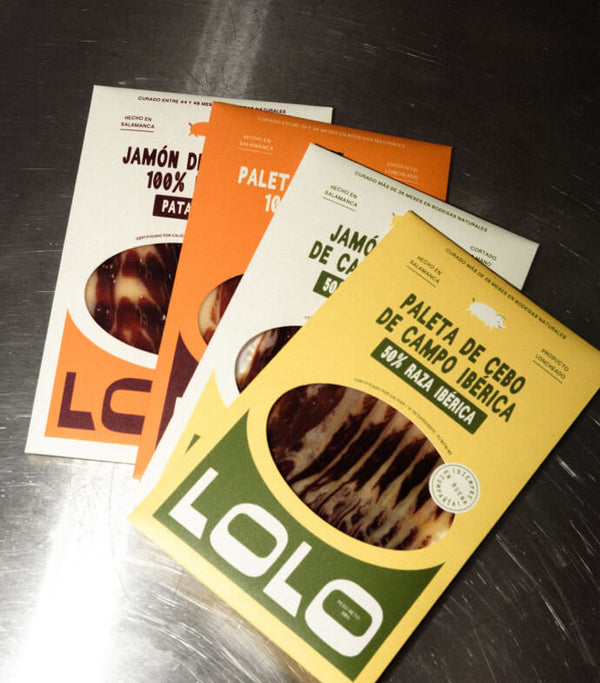
Curing comes afterwards, and it makes up for nothing. An Ibérico ham of 7 kg or more must cure for 730 days minimum, a shoulder for 365 days. Our acorn-fed pieces come out between 44 and 48 months, our free-range grain-fed around 36. But the cellar only concentrates what the pig has eaten.
A simple test to run at home
Run two plates under hot water, dry them, and lay a slice from a different piece on each. On the acorn-fed one, the fat turns glossy and translucent within seconds. On the free-range grain-fed one, it stays firm and white far longer. The difference is visible with no instrument at all.
Four things to look at when buying
- ✅ The colour of the seal, before the product name. Black and red mean montanera, green means free-range grain-fed, white means raised indoors.
- ✅ The breed percentage, which must be stated on the label. A red seal can mean a 50% or a 75% Ibérico animal. Both exist, and they are not the same piece.
- ✅ A price per kilo that adds up. An animal that occupied a hectare for two months cannot cost the same as one raised on two square metres.
- ❌ The words “natural”, “artisanal”, “from the land”. None of them is defined by the decree. They commit no one to anything.
Conclusion
It is all decided before slaughter
Texture, curing time, legal grade and therefore price are settled during the previous autumn. Salt, time and the cellar work on a material that is already fixed. That holds for the finest acorn-fed ham and for the plainest grain-fed one.
None of which means you should always buy acorn-fed. The three rearing systems answer different needs. Here is the order we suggest.
- Compare once, properly. Two 80 g packs served at the same temperature are enough to tell you which you prefer.
- Keep the acorn-fed for occasions when it will be eaten slowly. Its whole interest lies in how the fat behaves at room temperature.
- Take free-range grain-fed for everyday. It is the best balance between rearing standards and price per kilo.
Frequently asked questions
How many acorns does an Ibérico pig eat in a day?
About ten kilos. The Spanish Ministry of Agriculture puts the requirement at roughly 600 kg of whole acorns per animal for a full weight gain in montanera. Spread over the sixty-day minimum, that comes to around 10 kg a day, with wide swings depending on how much fruit is on the ground.
When does the montanera take place?
Animals enter the dehesa between 1 October and 15 December, and are slaughtered between 15 December and 31 March (art. 6.3). These dates are not indicative: they follow the natural acorn fall and mark out the window in which a batch can qualify for the “de bellota” designation.
Does a free-range grain-fed pig eat acorns?
It can, but nobody counts them. Free-range grain-fed is defined first by space, 100 m² per animal, and by a diet of cereals and pulses topped up by what the plot offers. That does not earn the “de bellota” designation, which requires the 46 kg gained in montanera. A grain-fed pig raised indoors has no access to acorns at all.
Why is oleic acid mentioned in connection with ham?
Because it is the trace the acorn leaves in the animal. It dominates the fat of the acorn, the pig stores it in its own, and analysis finds it there: at least 54% in an acorn-fed animal. It is also what makes that fat melt so low, and therefore what explains the texture. We draw no health claim from it.
How many hectares does one animal need?
Between a little under one hectare and four, depending on tree cover. The annex to the decree allows 1.25 animals per hectare where oaks cover more than a third of the plot, and only 0.25 where they cover a tenth. The fewer the oaks, the more land each animal needs.
Sources
- Royal Decree 4/2014, consolidated text published in the Boletín Oficial del Estado: art. 3 (breed percentages), art. 6 (montanera: dates, weights, gain, stocking density), art. 7 and 8 (free-range grain-fed and grain-fed), art. 9 (seal colours), art. 12 (minimum curing times), annex (animals per hectare). Consulted 23 August 2026.
- A. Mateos San Juan, “El cerdo ibérico. Factores que influyen en el crecimiento y en las características de la canal”, Ganadería, Spanish Ministry of Agriculture: acorn intake, weight gain and oleic acid. Consulted 23 August 2026.
- Curing times for our own pieces: LOLO Jamón catalogue, checked 23 August 2026.
Read next
Written by

Valentin & Pablo
Founders of LOLO Jamón
We select our pieces in the drying cellars of the Salamanca dehesa, and we filmed a full montanera season for our documentary Viva España.
Our pieces from the montanera
Acorn-fed 100% Ibérico hams and shoulders, Salamanca dehesa, cured 32 to 48 months depending on the piece. In 80 g packs or as a whole leg.
Explore the Bellota selectionShipped from Spain · free shipping over €89.90


Leave a comment
This site is protected by hCaptcha and the hCaptcha Privacy Policy and Terms of Service apply.