


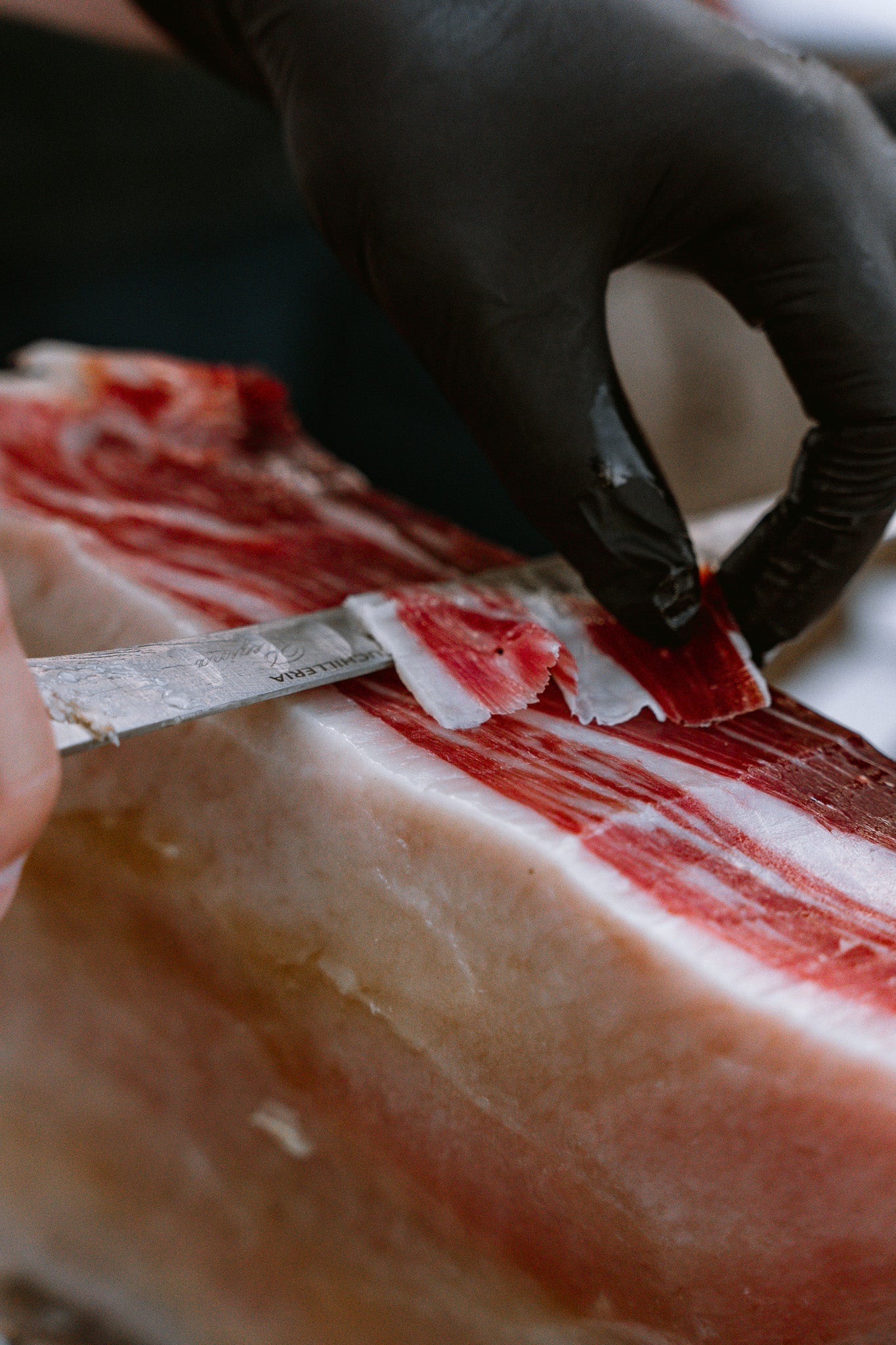
What is the best ham in the world?
The best ham in the world is not a brand — it is a category: acorn-fed 100% Ibérico ham, the one carrying the black seal. What remains is why, and at what price. This comparison puts nine great families of dry-cured ham side by side, with the official standards in hand.
The short answer
On the criteria you can actually verify — breed, diet and legally required curing time — acorn-fed 100% Ibérico ham is the most demanding of the nine families compared here. It is the only one whose standard imposes, all at once, a certified pure breed, a season of acorns in the open and 730 days of curing on pieces of 7 kg or more.
- Legal minimum curing: 730 days for an Ibérico ham of 7 kg or more, 600 days below that weight (Royal Decree 4/2014, art. 12).
- The two most serious challengers: France’s Jambon noir de Bigorre PDO (20 months minimum) and Prosciutto di Parma PDO (14 months minimum).
- Prices checked on 20 August 2026: €81 to €93 per kilo for a whole acorn-fed 100% Ibérico leg in our catalogue, against €311 per kilo for the same ham in an 80 g hand-carved pack.
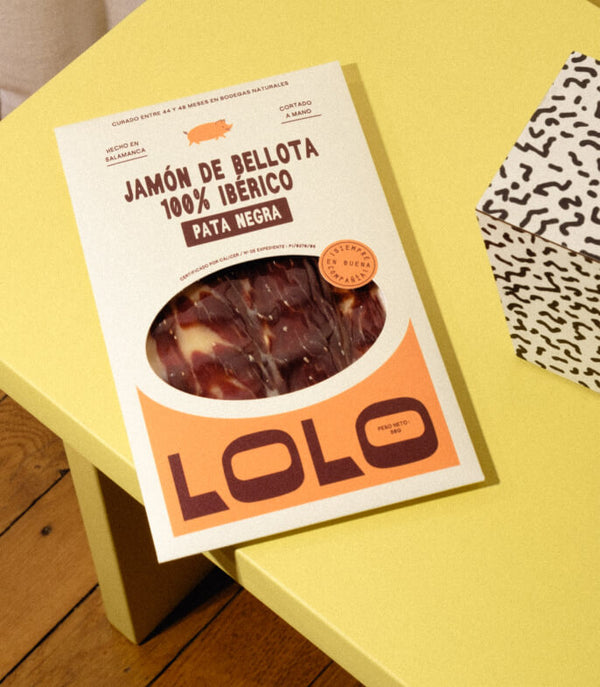
- What to watch for: “Pata Negra” should only ever describe the black seal. A red seal is a crossbred acorn-fed ham, 50% or 75% Ibérico — not the same product, and not the same price.
Where this information comes from
The curing times and breed percentages quoted here come from official texts, not from sales sheets: the Spanish royal decree and the French and Italian specifications, all listed at the foot of the page. The descriptions of taste come from our own tastings: we say so because that is not a measurement. And we import and sell Iberian ham — you should know that before reading the above. It is also why this article ranks no brands and quotes no competitor prices: we did not carry out that survey. It was prepared with writing-assistance tools, then checked and signed by us.
The nine great families of dry-cured ham, compared
Only one criterion compares objectively from country to country: the minimum time the product specification imposes on the producer. Everything else — breed, diet, farming method — is read from those same texts. This table does not tell you which ham you will prefer; it tells you what each designation guarantees.
| Ham | Breed and diet | Min. curing |
|---|---|---|
| Acorn-fed 100% Ibérico black seal · Spain | 100% Ibérico acorns, free-range | 730 days * |
| Acorn-fed Ibérico red seal · Spain | 50% or 75% Ibérico acorns, free-range | 730 days * |
| Free-range grain-fed Ibérico green seal · Spain | 50–100% Ibérico pasture and cereals | 730 days * |
| Grain-fed Ibérico white seal · Spain | 50–100% Ibérico cereals, indoors | 730 days * |
| Jambon noir de Bigorre PDO France, Hautes-Pyrénées | Purebred Gascon pig pasture, 20 pigs/ha max | 20 months |
| Jambon sec de Corse PDO France, Corsica | Purebred Nustrale pig acorns and chestnuts, free-range | Over 4 months *** |
| Prosciutto di Parma PDO Italy, Emilia-Romagna | Italian heavy pigs cereals and whey | 14 months |
| Prosciutto di San Daniele PDO Italy, Friuli | Italian heavy pigs cereals, indoors | 13 months |
| Jambon de Bayonne PGI France, South-West | South-West basin pigs cereals, indoors | 7 months ** |
* 730 days for pieces of 7 kg and over, 600 days below that (Royal Decree 4/2014, art. 12). ** From salting. *** Minimum age 12 months at first sale.
One absence deserves an explanation. Hungarian Mangalica ham falls, as far as we know, under no European PDO or PGI: there is no enforceable minimum curing time to quote. Corsican dry-cured ham, on the other hand, is now in the table. Its specification has the pigs slaughtered between 12 and 36 months. A white pig goes to slaughter at around 8 to 10 months. As for jamón serrano, it comes from white pigs and falls under a traditional speciality guaranteed scheme, not the Ibérico standard: a different product, not a competitor to acorn-fed Ibérico. We break this down in our article on the differences between Ibérico breed percentages.
Check this before you buy
Plenty of retailers call any red-seal — sometimes even green-seal — ham “Pata Negra”. The black seal is the only one guaranteeing a 100% Ibérico pig fed on acorns. Look at the seal, not at the product title: the seal is the only wording in the decree that guarantees both breed and diet.
What the Spanish standard actually says: four seals, two variables
The colour of the seal combines two separate pieces of information: breed and diet. Article 9 of Royal Decree 4/2014 assigns black to the designation “de bellota 100% ibérico”, red to “de bellota ibérico”, green to “de cebo de campo ibérico” and white to “de cebo ibérico”.
The most widespread confusion concerns the red seal. You will often read that it means “75% Ibérico”. That is incomplete: article 3 of the same decree sets the threshold at 50% minimum Ibérico genetics. A red-seal ham can therefore be 50% or 75%, and stating the exact percentage on the label is compulsory. Two legs carrying the same red seal can differ noticeably.
The third factor, invisible on the seal, is where the ham was cured. Jabugo, Guijuelo, Dehesa de Extremadura and Los Pedroches do not dry in the same climate, and you can taste it. That is the subject of our guide to the producing regions and designations of origin of Ibérico ham.
What it really costs, per kilo
Price per kilo is the only unit that lets you compare an 80 g pack with an 8 kg leg. These are our own prices, taken from our catalogue on 20 August 2026, in euros. They are the only figures we can stand behind: we have not surveyed other sellers’ prices, and we are not going to invent them.
| Category and format | Price | Per kilo |
|---|---|---|
| Acorn-fed 100% Ibérico ham whole leg, 7 to 8 kg | €649.90 | €81–93 |
| Acorn-fed 100% Ibérico ham hand-carved, 80 g | €24.90 | €311 |
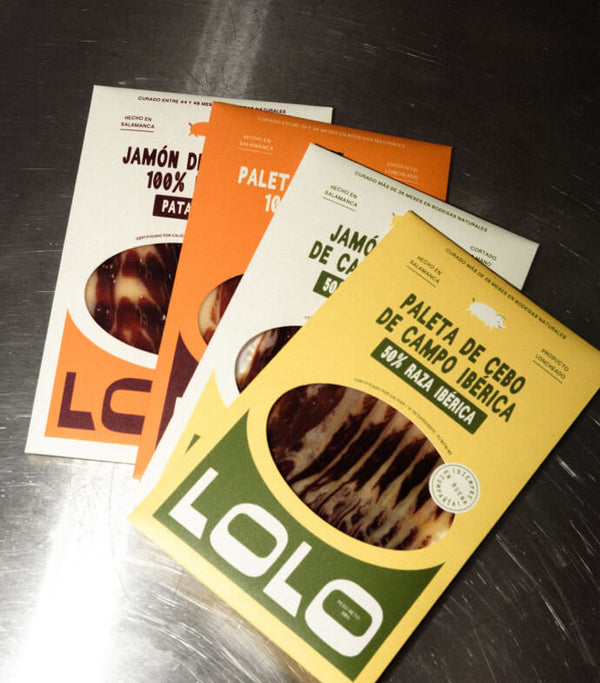
| Acorn-fed 100% Ibérico shoulder sliced, 80 g | €15.90 | €199 |
| Free-range grain-fed 50% ham hand-carved, 80 g | €14.90 | €186 |
| Free-range grain-fed 50% shoulder sliced, 80 g | €10.90 | €136 |
Per-kilo prices rounded. The whole leg is bone-in.
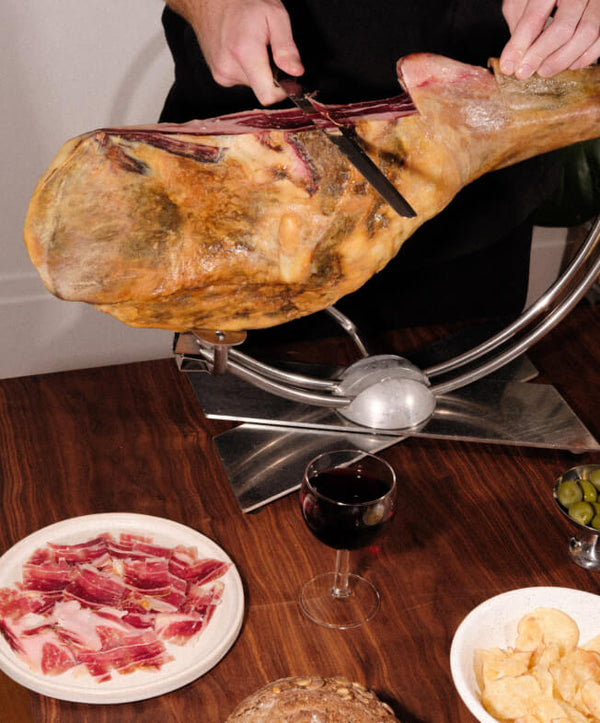
The most revealing gap in this table points straight at us: the same ham costs three to four times more per kilo in an 80 g pack than as a whole leg. There are good reasons — hand carving, boning, trim loss, protective-atmosphere packing, cold chain — but it deserves to be said plainly. If you eat Ibérico ham regularly and you can carve, the whole leg is far more rational. The pack earns its place for discovering, for gifting, or when you have neither the time nor a ham stand.
What actually changes on the palate
The perceptible difference between acorn-fed and free-range grain-fed comes down to a melting point, not an adjective. The infiltrated fat of a bellota pig melts lower than that of a cebo de campo — around the temperature of your hand. In practice, a slice laid on a warm plate turns translucent within seconds.
The Italian hams play another tune, and that is a choice, not a flaw. Parma and San Daniele salt less and give a softer bite. Acorn-fed Ibérico goes for length on the palate. Noir de Bigorre sits somewhere else again: rustic breed, pasture, twenty months minimum.
That is also why a blind tasting can produce an unexpected winner. We know of no published tasting that has set these nine families against each other, and that is exactly the point: a standard guarantees a production framework, not a universal taste.
One move changes the taste more than anything else: take the ham out of the fridge 30 to 45 minutes before serving, and aim for 21–24 °C on the plate. Below that the fat stays set and a good part of the aromas never reaches you.
Who it is for, and who it is not for
- Yes, if you want the most written guarantees. Acorn-fed 100% Ibérico is the most demanding of the nine categories compared here.
- Yes, if you entertain often and can carve. The whole leg divides the price per kilo by three or four.
- Yes, if you want to understand before investing. One 80 g hand-carved pack settles the question in a single tasting.
- No, if you prefer mild, lightly salted hams. A Parma PDO will suit your palate better, and cost less.
- No, if you want ham for everyday cooking. Acorn-fed Ibérico is meant to be eaten raw. For stock or croquettes, a cebo de campo does the job.
Conclusion
One category wins, the taste is still yours
On verifiable criteria, black-seal acorn-fed 100% Ibérico ham comes first among the nine families compared. Certified pure breed, free-range acorn diet, and the longest minimum curing time of every designation examined. No other European specification imposes all three at once.
That does not settle the question of your own preference, and we will not pretend otherwise. A slice of Parma on warm bread on a Sunday morning needs no defending. Here is simply the order we would suggest.
- Start with a black-seal 100% acorn-fed ham, hand-carved. An 80 g format is enough to settle it, for under €25.
- Compare it with cebo de campo in the same sitting, at 21–24 °C. The difference in melt is visible before it is tasted: the acorn-fed slice turns translucent far sooner.
- Only then move to a whole leg. At €81–93/kg against €311/kg the saving is real — but it assumes a stand, a good knife, and the appetite for carving.
Frequently asked questions
What is the difference between Serrano ham and Ibérico ham?
The breed of pig, first and foremost. Serrano comes from white pigs (Duroc, Landrace, Large White) raised indoors on cereals. Ibérico ham comes exclusively from Ibérico-breed pigs, at 50% minimum, and falls under Royal Decree 4/2014, which requires 600 to 730 days of curing. Two distinct regulations, not two tiers of the same product.
Why is Ibérico ham so expensive?
Because the standard forces the producer to tie up the leg for two years, and the animal for far longer still. A ham of 7 kg or more must cure for 730 days before it can be sold, during which the producer carries the cost and the piece loses weight. Add extensive farming, which demands several hectares of dehesa per animal, and the fact that each pig yields only two hams.
Is a red-seal ham a Pata Negra?
No. The red seal designates a ham “de bellota ibérico”: the pig was indeed acorn-fed and free-range, but it is crossbred, 50% or 75% Ibérico. “Pata Negra” should only ever apply to the black seal, the decree’s sole “100% ibérico” designation. It is a distinction plenty of product pages quietly skip.
How do you store a whole ham once it has been started?
Cool, dry, in open air. Aim for 15 to 20 °C, on a ham stand, in a ventilated room. Cold does not make a ham unsafe; it hardens the slice without giving it anything. But if your kitchen reaches 30 °C in August, move the piece somewhere cool without hesitating. Cover the cut surface with the first slice of fat or a clean cloth, and remove the first 2 to 3 millimetres before each new carving session. We set it all out in keeping a started ham at home.
What is the best ham in the world outside Spain?
Judged purely on how demanding the specification is, Jambon noir de Bigorre PDO. Twenty months minimum production time, and a purebred pig registered in the LIGERAL herd book: it is the closest framework to acorn-fed Ibérico among non-Spanish designations.
Sources and verification
- Royal Decree 4/2014, consolidated text published in the Boletín Oficial del Estado — articles 3 (breed percentages), 9 (seal colours) and 12 (minimum curing times). Consulted 20 August 2026.
- Product specification for the PDO “Jambon noir de Bigorre”, INAO. Consulted 20 August 2026.
- Single document for the PGI “Jambon de Bayonne”, INAO. Consulted 20 August 2026.
- “Prosciutto di Parma PDO” entry, European Commission. Consulted 20 August 2026.
- “Prosciutto di San Daniele PDO” entry, Italian Ministry of Agriculture (Masaf). Consulted 20 August 2026.
- Specification for the “Jambon sec de Corse - Prisuttu” designation, official bulletin of the French Ministry of Agriculture.
- Prices taken from the LOLO Jamón catalogue on 20 August 2026. No competitor price survey was carried out.
Read next
- What is the best pig in the world? A guide to the breeds
- What a Pata Negra ham really costs
- How to choose your Ibérico ham or shoulder: the practical guide
- The montanera in the Salamanca dehesa: what the pigs actually eat
- Ham fairs and events in Spain
- Our acorn-fed 100% Ibérico hams and shoulders (Pata Negra)
- Our free-range grain-fed 50% Ibérico hams and shoulders
Written by

Valentin & Pablo
Founders of LOLO Jamón
We select our pieces directly from the drying cellars of the Salamanca dehesa, and we filmed a full montanera season for our documentary Viva España.
Start with the black seal
Acorn-fed 100% Ibérico hams and shoulders, Salamanca dehesa, cured 32 to 48 months depending on the piece. In 80 g packs or as a whole leg.
Explore the Bellota selectionShipped from Spain · Free shipping over €89.90



1 comment
Bonjour 👋
Vous êtes à Jabugo?
Vous connaissez Manchenieto à Jabugo?
Merci de me dire votre meilleur prix pour
Un jambon de 8/9 kg 100/% bellota de 45 à 48 mois,svp
Cordialement
Alain Boudot
Alain Boudot
Leave a comment
This site is protected by hCaptcha and the hCaptcha Privacy Policy and Terms of Service apply.