Animal welfare and extensive farming in the dehesa
The dehesa is not a forest. It is a landscape people have maintained for centuries so that animals can live under oak trees. It is credited with a great many virtues, some of which do not survive checking. Here is what can be said about it with sources, and what cannot.
The essentials
The difference between dehesa farming and indoor farming is not a story, it is a measurement: 0.65 m² per animal on one side, several hectares on the other.
- The dehesa covers around 3.5 million hectares in Spain, plus close to a million hectares of montado in Portugal.
- It is a habitat protected by the European Union under code 6310, and its conservation status is assessed as unfavourable.
- It is not inscribed on the UNESCO World Heritage List. It is, however, at the heart of three biosphere reserves.
- Three claims you read everywhere do not hold up against the sources. We list them, and we say why.
Where this information comes from
The surface areas and the definition of the dehesa come from the Libro Verde de la Dehesa, the Spanish scientific consensus document, and from the Portuguese national forest inventory. The stocking densities come from European directive 2008/120/EC and from Real Decreto 4/2014. The protection status comes from the Habitats Directive and from the UNESCO MAB programme records.
We sell ham that comes from this dehesa, so we have every interest in speaking well of it. That is exactly why we checked each claim before writing it, and why we removed several.
What a dehesa is
The reference definition is precise: a farming system in which at least half the surface is pasture, under a canopy of scattered mature acorn-bearing trees, that canopy covering between 5 and 60 % of the ground. In other words, neither forest nor meadow, but a maintained middle ground.
Around 3.5 million hectares in Spain, across 1,300 municipalities. Extremadura holds 35 % and Andalusia 27 %, but Castilla-La Mancha holds 21 % and Castilla y León 13 %. It is in the latter that the province of Salamanca sits, where our pieces come from. In Portugal, the montado adds close to another million hectares.
On its age, some caution is due. The word dehesa appears in medieval texts, but it then meant enclosed private pasture, with no reference to a type of vegetation. The open wooded parkland we know today took hold in the nineteenth and twentieth centuries. You will often read “two thousand years”: the standard historical research does not say that.
The space, in figures and on the ground
This is the most telling figure, and it needs no commentary. Every value here is set by regulation.
| Farming system | Space per animal | Text |
|---|---|---|
| Indoors, 85 to 110 kg | 0.65 m² | Directive 2008/120/EC |
| Indoors, over 110 kg | 1 m² | Directive 2008/120/EC |
| Cebo de campo, over 110 kg | 100 m² | Real Decreto 4/2014 |
| Montanera, by tree cover | 8,000 to 40,000 m² | Real Decreto 4/2014 |
Minimum space per animal. During the montanera, stocking is capped at 0.25 to 1.25 pigs per hectare depending on tree density, which gives the areas shown.
The gap runs from one to several tens of thousands. This is not a judgement on indoor farming, which feeds most of the population and follows demanding rules. It is simply a different order of magnitude, and it explains a good part of the price of an acorn-fed ham. What the animal eats in that space is covered in our article on what the Iberian pig eats.
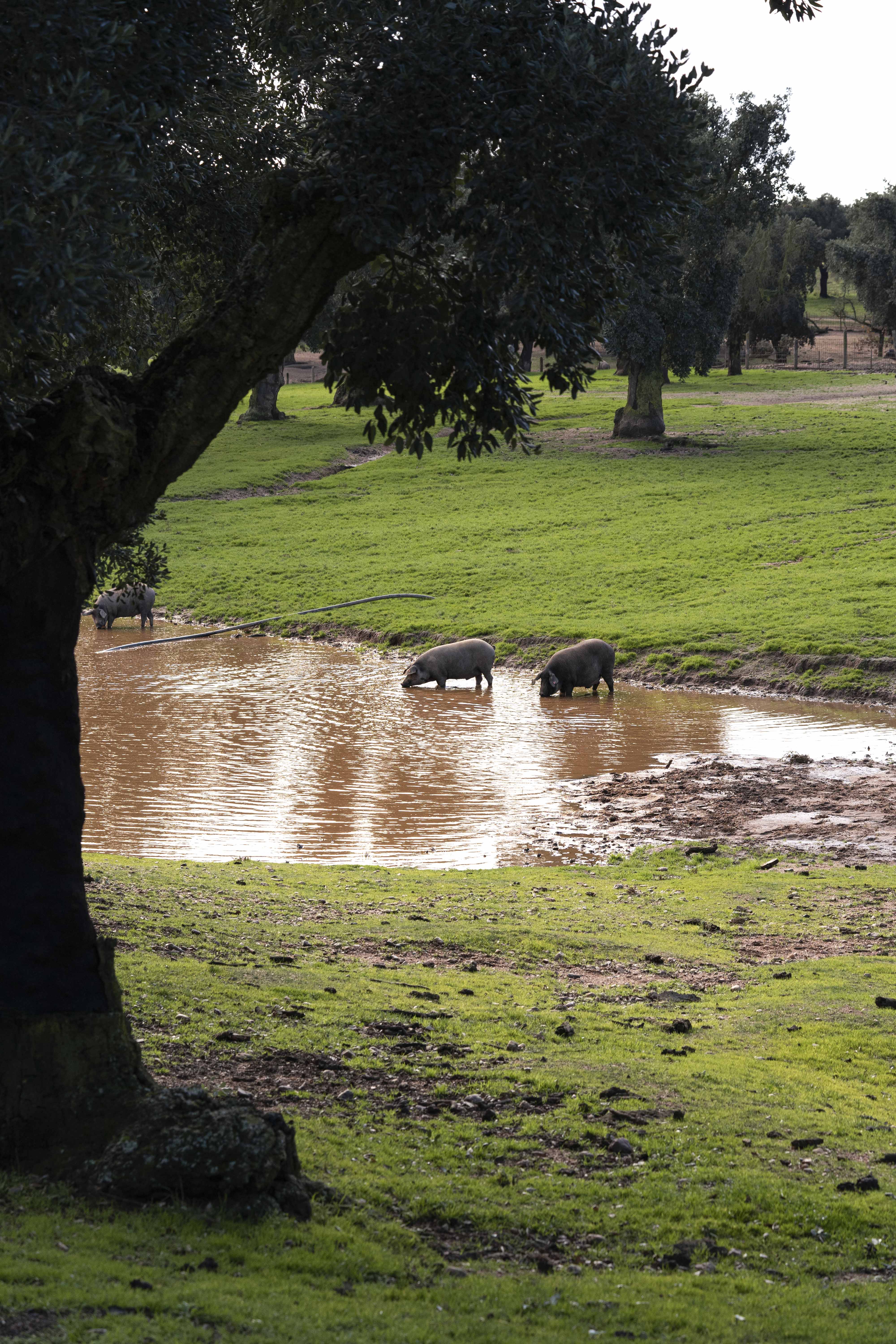
That space is not only a matter of comfort. The pig has no functional sweat glands for evaporative cooling: it regulates its temperature through behaviour, seeking shade and wallowing in mud. Under the oaks it can do so. That is a physiological constraint, not a preference.
Those figures are the law’s. These are the ones from the farm our pieces come from, in the Salamanca dehesa, where we go in every season.
There, the montanera runs at roughly one hectare per animal, ten thousand square metres each. Set that against the table above.
The plots mix holm oaks and cork oaks. The tree cover is not uniform: it changes from one plot to the next, and the landscape changes again with the seasons. That is precisely why the standard works in a range rather than a single figure.
There is a large watering point and natural shelter, and the farm is properly equipped: it is a complete operation, which makes its own feed mix for use outside the montanera. It is not certified organic, and we will not present it as such.
We will not say more about it, and that is deliberate: it is not our farm, it is that of a producer we work with.
The five freedoms, and what they are worth
They get quoted the moment animal welfare comes up. They were formalised in 1979 by the British Farm Animal Welfare Council, following on from the 1965 Brambell report: freedom from hunger and thirst, freedom from discomfort, freedom from pain, injury and disease, freedom to express normal behaviour, and freedom from fear and distress.
Two points almost nobody makes. This framework has no binding force in the European Union: the legal obligations are set by directive 98/58/EC, which does not mention the five freedoms. And the council that formulated them was renamed the Animal Welfare Committee in 2019.
None of that takes away their usefulness as a framework. It simply means that announcing “we respect the five freedoms” is not a certification. It is a statement.
Four things we will not say
That the dehesa is UNESCO World Heritage. It is not, and it does not appear on Spain’s tentative list either. Its real status is further down this article, and it is already solid.
That it is a carbon sink. The only published measurements, at an instrumented site in Extremadura between 2016 and 2023, show the control plot as a net source of CO₂. Its soils store carbon, which is not the same as absorbing it every year.
That a natural diet strengthens the animals’ immune system. The literature on this is inconsistent and does not support the claim.
That the ailments of intensive farming are absent here. No comparative study establishes it, and on joint disorders the only one available points the other way. Space does not confer immunity from everything.
What the dehesa does to the landscape
On biodiversity, the credible figures are more modest than the ones in circulation, and telling enough. The Andalusian administration counts around sixty breeding bird species in its dehesa formations, more than twenty mammal species, and as many reptiles and amphibians. Among the birds, the Spanish imperial eagle, in danger of extinction, and the black stork.
The dehesa’s annual pastures are among the richest in the world in herbaceous plants: the Libro Verde speaks of more than seventy species per square metre. That is a density, not a total, and it is what makes it remarkable.
On wildfire, the mechanism is recognised by the public authorities. Since 2005 the regional government of Andalusia has run a network of firebreaks maintained by livestock: by grazing, the animals reduce the fuel load and create discontinuities that slow the spread of fire. The scheme covers wooded areas well beyond the dehesa alone, but the principle is the same.
One last point, since you often read that the dehesa’s oaks are thousands of years old: the cork oak lives around a hundred and seventy years, and can be stripped some fifteen times in its life. That is already long on the scale of a farm.
Its real protection status
The dehesa is a habitat of Community interest under the Habitats Directive, code 6310, "dehesas with evergreen Quercus". Spain holds more than three quarters of it, Portugal a sixth. That is European protection, binding on member states.
It is also at the heart of three biosphere reserves under the UNESCO MAB programme: Dehesas de Sierra Morena, designated in 2002 over 424,400 hectares and the largest reserve in Spain, Monfragüe in 2003, and La Siberia in 2019.
One thing the official reports mention less readily should be added: the conservation status of this habitat is assessed as unfavourable and deteriorating in the Mediterranean region. The ageing of the trees, the lack of regeneration and the disease pressure on the oaks are all documented. An acorn-fed ham depends on an environment that is faring worse than the story suggests.
Conclusion
A landscape that needs to be farmed
That is the paradox of the dehesa. It is not a natural space that needs protecting from livestock: it is a landscape created by livestock, and it closes over or degrades when animals stop grazing it.
The argument stands, then, without needing to be inflated. No world label and no invented health virtues are required: a few hectares per animal, a habitat protected across Europe, and an environment that needs its herds to hold together.
Frequently asked questions
Is the dehesa a UNESCO World Heritage site?
No, and it does not appear on Spain’s tentative list either. It is, however, at the heart of three biosphere reserves under the UNESCO MAB programme, including Dehesas de Sierra Morena, the largest reserve in Spain, and it is a habitat protected by the European Union under code 6310.
How much space does an Iberian pig have during the montanera?
Spanish rules allow 0.25 to 1.25 pigs per hectare depending on tree density, that is, between 8,000 and 40,000 m² per animal. By comparison, the European directive requires 0.65 m² per pig of 85 to 110 kg in indoor farming.
What are the five freedoms of animal welfare?
Freedom from hunger and thirst, freedom from discomfort, freedom from pain, injury and disease, freedom to express normal behaviour, and freedom from fear and distress. They were formalised in the United Kingdom in 1979 and have no binding force in the European Union, where directive 98/58/EC applies.
How large is the dehesa?
Around 3.5 million hectares in Spain, across 1,300 municipalities, chiefly in Extremadura, Andalusia, Castilla-La Mancha and Castilla y León. The Portuguese montado adds close to another million hectares.
Can a dehesa farm be certified organic?
Yes, but the certification is not attached to the system: it is individual and voluntary. The European organic production regulation prohibits the preventive use of antibiotics; curative treatment of a sick animal remains allowed, limited to what is necessary and with a doubled withdrawal period.
Sources
- Definition, surface areas and floristic richness: Libro Verde de la Dehesa y el Montado. Hacia una Estrategia Ibérica de gestión, version of 20 May 2010, coordinated by Fernando Pulido and Álvaro Picardo, the Spanish scientific consensus document, with Ministry of Agriculture data. Montado surface area: sixth Portuguese national forest inventory.
- Stocking densities: directive 2008/120/EC, transposed in Spain by Real Decreto 1135/2002, and Real Decreto 4/2014 for cebo de campo and the montanera.
- Protection status: Habitats Directive 92/43/EEC, habitat 6310 factsheet and Article 17 reporting; UNESCO MAB programme biosphere reserve records.
- Five freedoms: Farm Animal Welfare Council, 2009 report, and directive 98/58/EC.
- Pig thermoregulation: Contreras-Jodar, Escribano, Cerón et al., Reducing Stocking Densities and Using Cooling Systems for More Adapted Pigs to High Temperatures When Reared in Intensive Conditions, Animals, 2023: pigs have few functional sweat glands and, outdoors, cope with heat by looking for shade and wallowing in mud.
- Biodiversity: regional government of Andalusia and the LIFE BioDehesa project, University of Córdoba. Grazed firebreaks: Junta de Andalucía. Carbon balance: Nadolski, El-Madany, Nelson et al., Altered seasonal sensitivity of net ecosystem exchange to controls driven by nutrient balances in a semi-arid savanna, Biogeosciences, 2025, on the Majadas de Tiétar dehesa in Extremadura; and Uribe, Inclán, Hernando et al., Grazing, tilling and canopy effects on carbon dioxide fluxes in a Spanish dehesa, Agroforestry Systems, 2015. History: Martín Vicente and Fernández Alés, Long Term Persistence of Dehesas. Evidences from History, Agroforestry Systems, 2006.
- What is said about the farm we source from comes from our own visits, in every season of the year.
- All of these sources were re-read on 25 August 2026. Claims we could not source have been removed, and we say so in the article.
Read next
Written by
Valentin & Pablo
Founders of LOLO Jamón
We select our pieces in the drying cellars of the Salamanca dehesa, and we filmed a full montanera season for our documentary Viva España.
The taste of a few hectares per animal
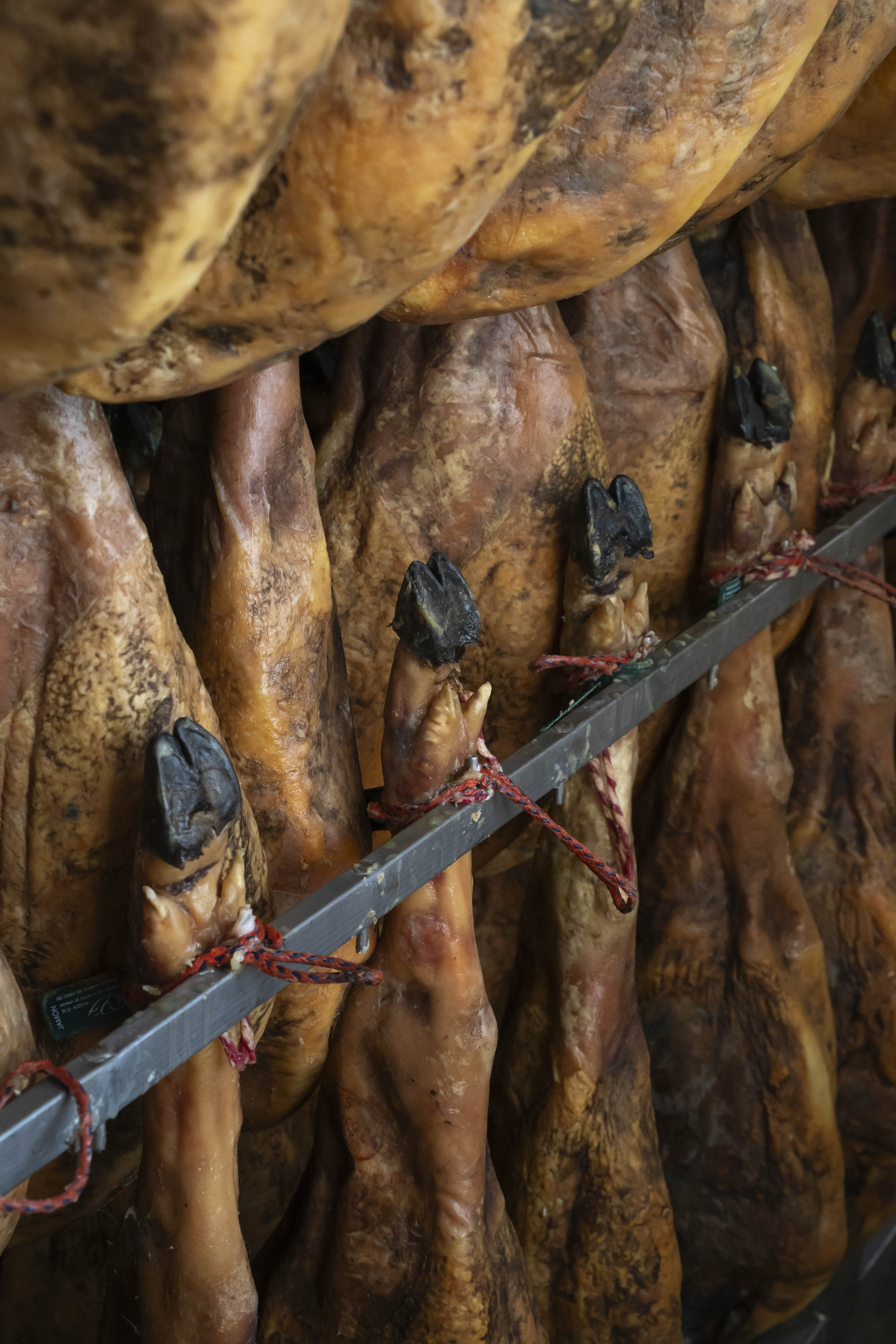
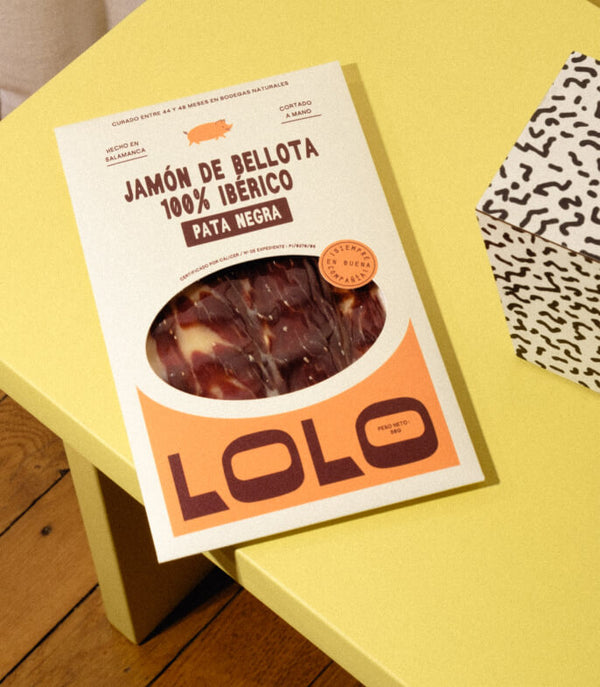
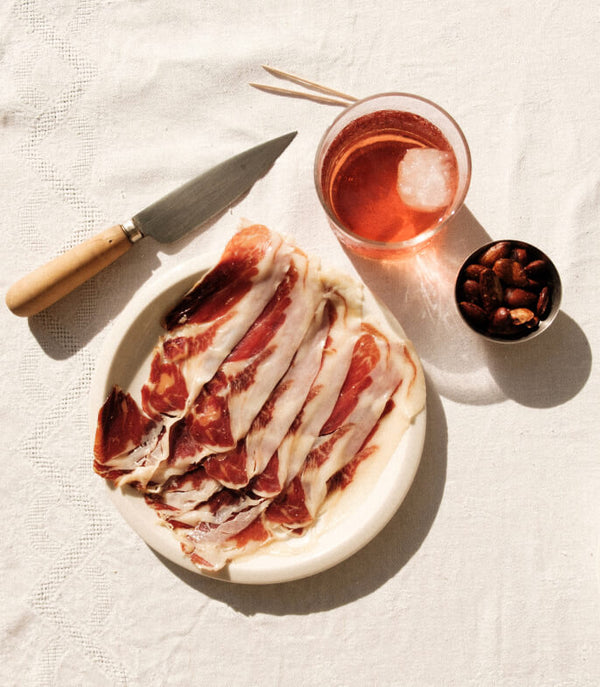
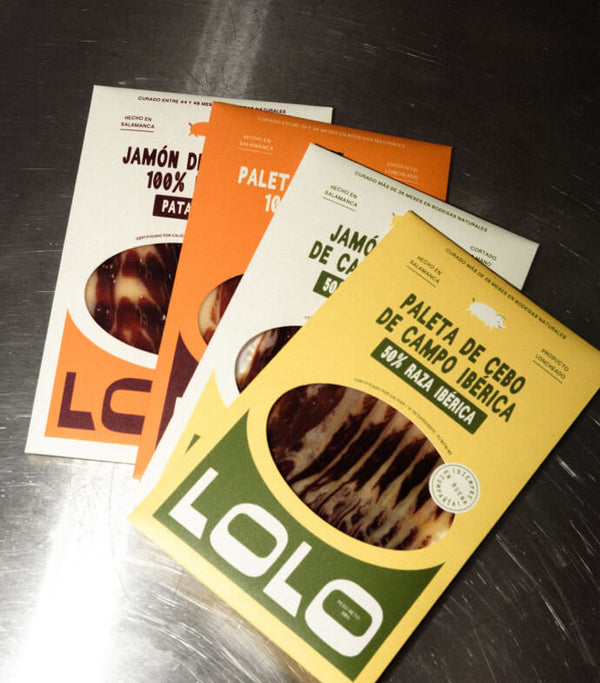
100 % Iberian acorn-fed jamones and paletas, Salamanca dehesa, black seal. As a whole piece or as an 80 g hand-carved pack.
See the Bellota selectionThe cebo de campo range is here · free shipping over €89.90


Leave a comment
This site is protected by hCaptcha and the hCaptcha Privacy Policy and Terms of Service apply.